


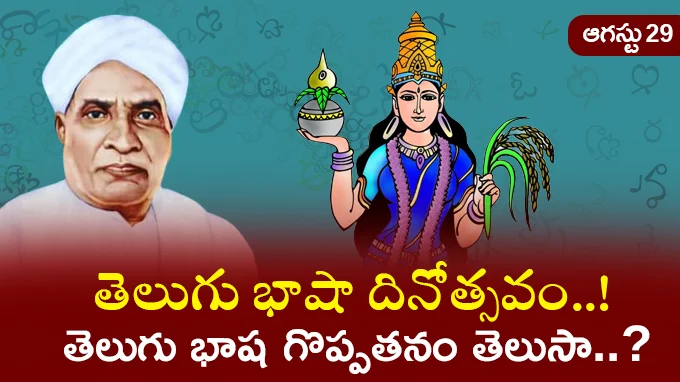
“Desa Bhashalandu Telugu Lessa” — the famous words attributed to Vijayanagara emperor Sri Krishnadevaraya continue to echo the pride and glory of the Telugu language. And when the iconic song “Cheyyethi Jai Kottu Telugoda.. Gatam entho Ghanakeerthi Galavoda” is heard, it evokes a deep sense of pride among Telugu-speaking people.
Belonging to the Dravidian language family, Telugu is one of India’s 22 constitutionally recognized languages. In Andhra Pradesh, Telugu was declared the official language of the state through the Official Language Act in 1966. Telugu is also recognized as an official language in Yanam, a Union Territory region.
Telugu is one of the most widely spoken languages in India, ranking among the country’s major languages after Hindi and Bengali. Beyond Andhra Pradesh and Telangana, large Telugu-speaking communities can be found across several Indian states and in countries including the United States, Australia, Canada, the United Kingdom and Gulf nations.
A Classical Language of India
Telugu achieved another major milestone in 2008, when the Government of India granted it Classical Language status, recognizing its rich literary heritage, antiquity and unique linguistic traditions.
From the works of great poets to timeless classics such as Vemana Padyalu and Sumati Satakam, Telugu literature has preserved generations of wisdom, culture and social values.
Gidugu Ramamurthy — The Man Who Fought for Telugu
Every year, August 29 is observed as Telugu Language Day, commemorating the birth anniversary of renowned Telugu scholar and language reformer Gidugu Venkata Ramamurthy.
Gidugu Ramamurthy played a historic role in making Telugu more accessible to ordinary people. He strongly advocated the use of Vyavaharika Bhasha — the language spoken by common people — instead of an overly formal literary style.
His efforts transformed the way Telugu was viewed and taught, making him one of the most influential figures in the history of modern Telugu language reform.
But Is Gidugu’s Dream Truly Being Fulfilled?
While Telugu continues to enjoy a rich cultural legacy, an important question remains: Are we doing enough to preserve the language for future generations?
With globalization, technology and the growing influence of other languages, there is a growing need to ensure that younger generations remain connected to their mother tongue.
Preserving Telugu is not the responsibility of governments alone. Parents, teachers and every Telugu-speaking person have a role to play.
Telugu Takes Center Stage in Schools
Governments and educational institutions are encouraging schools to celebrate Telugu Language Day with students and teachers participating in special programmes.
Vemana poems, Sumati Satakam verses, essay-writing competitions, elocution contests, poetry recitations and cultural performances are being organized to create greater interest and affection for Telugu among students.
Such initiatives aim not only to celebrate the language for a day, but also to encourage children to understand and embrace their linguistic and cultural roots.
If Telugu Has to Survive, We Must Speak It
A language cannot survive merely inside books and classrooms. It must be spoken at home, taught to children, read, written and passed on to the next generation.
Telugu is more than just a means of communication. It represents our history, culture, traditions, literature and identity.
So, on Telugu Language Day, there is one question every Telugu speaker should ask:
Gidugu Ramamurthy fought to strengthen Telugu.
What are we doing to carry that legacy forward?
Let us speak Telugu.
Let us read Telugu.
Let us write Telugu.
And let us pass our mother tongue on to future generations.