


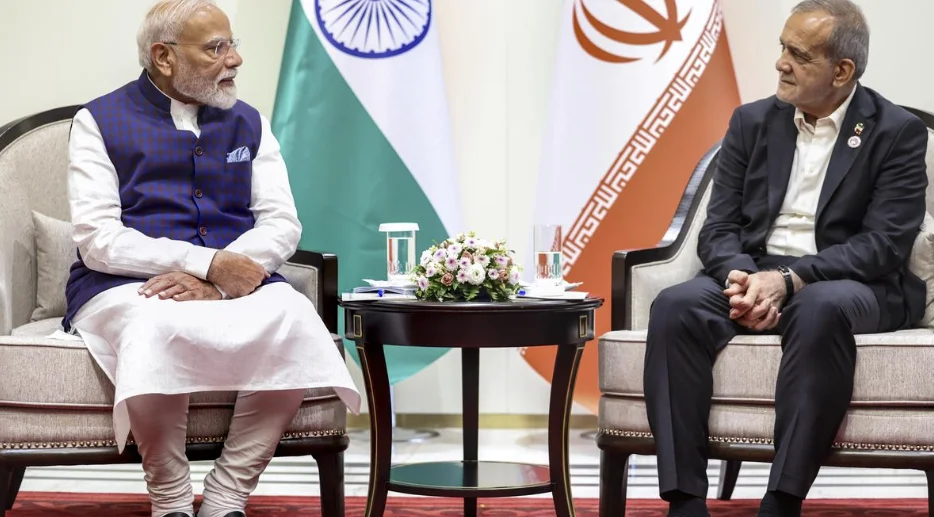
Prime Minister Narendra Modi met Iranian President Masoud Pezeshkian on Monday on the sidelines of the Shanghai Cooperation Organisation summit in Bishkek, Kyrgyzstan.
The meeting took place against the backdrop of heightened tensions in West Asia, giving the discussions added diplomatic significance. The two leaders reviewed bilateral relations as well as the latest developments in the region.
Bilateral Relations Take Centre Stage
During the meeting, Modi reaffirmed India’s commitment to strengthening its long-standing friendship with Iran across a range of sectors.
The Prime Minister also said India wanted to expand and diversify its trade basket with Iran in the coming period.
The emphasis on trade reflects New Delhi’s interest in broadening economic engagement with Tehran beyond existing areas of cooperation.
West Asia Situation Discussed
The two leaders also reviewed recent developments in the West Asia region.
The discussions came at a time when the region is facing heightened military and geopolitical tensions. India reiterated its consistent position that outstanding issues should be addressed through dialogue and diplomacy rather than further escalation.
Modi also underlined the need for continued international efforts to ensure lasting peace and stability in the region.
India Stresses Freedom of Navigation
Another important issue raised during the meeting was the safety of commercial shipping and maritime trade.
India stressed the importance of protecting freedom of navigation and commerce, particularly amid regional instability that could affect international shipping routes.
Modi also emphasised that civilians, civilian infrastructure, commercial vessels and seafarers should not be targeted under any circumstances.
Significance for Iran
The meeting was particularly important for Iran, which is seeking greater diplomatic engagement with other countries amid the ongoing regional crisis.
Pezeshkian’s participation in the SCO summit provided Tehran with an opportunity to engage with major regional powers, including India, China and Russia.
His meeting with Modi therefore carried significance beyond the two countries’ bilateral relationship, particularly because of the wider security situation in West Asia.
India’s Diplomatic Position
India has consistently advocated dialogue and diplomacy as the preferred route for resolving conflicts in West Asia.
Modi’s meeting with Pezeshkian provided another opportunity for New Delhi to reiterate that position.
India’s approach reflects its effort to maintain relations with different countries in the region while avoiding direct alignment with any one side in regional conflicts.
Focus on Expanding Trade
Trade is an important component of the India-Iran relationship.
Modi’s call for expanding and diversifying the bilateral trade basket indicates an interest in developing cooperation across a wider range of products and economic sectors.
Greater diversification could help the two countries reduce dependence on a limited number of trade categories and create additional opportunities for businesses in both countries.
Importance of the SCO Platform
The SCO summit is also providing an opportunity for participating leaders to hold bilateral meetings alongside the main summit.
For India, these meetings provide a platform to discuss bilateral ties, regional security, economic cooperation and connectivity with key partners.
The Modi-Pezeshkian meeting was therefore one of several important bilateral engagements taking place around the Bishkek summit.
Strategic Importance of Iran for India
Iran remains an important partner for India in the wider West Asian region.
The relationship has strategic relevance in areas including trade, energy, connectivity and India’s access to markets and transport routes linking the region with Central Asia.
Maintaining stable relations with Tehran is therefore important for India even as the regional security environment becomes more complicated.
Meeting Comes at a Critical Time
The meeting between Modi and Pezeshkian comes at a particularly sensitive moment for West Asia.
The ongoing regional tensions have implications not only for security but also for energy supplies, shipping, trade and the wider global economy.
For India, ensuring the safety of Indian citizens and commercial interests in the region remains an important consideration.
The two leaders’ discussion therefore had both bilateral and broader regional significance.
Scope for Future Cooperation
The meeting could provide momentum for further engagement between India and Iran in trade and other areas.
At the same time, India is expected to continue using diplomatic channels to encourage de-escalation and greater regional stability.
The emphasis on dialogue, safe maritime routes and expanded trade reflects India’s broader effort to protect its economic and strategic interests while supporting peace in the region.
Conclusion
Prime Minister Narendra Modi’s meeting with Iranian President Masoud Pezeshkian on the sidelines of the SCO Summit in Bishkek focused on bilateral relations, trade and the evolving situation in West Asia. Modi reaffirmed India’s commitment to strengthening its long-standing relationship with Iran and expressed an interest in expanding and diversifying bilateral trade.
India also reiterated its position that regional disputes should be resolved through dialogue and diplomacy. Modi stressed the importance of lasting peace and stability as well as protecting freedom of navigation and commerce.
With West Asia facing heightened tensions, the meeting carries significance for both India-Iran relations and the wider regional diplomatic effort.