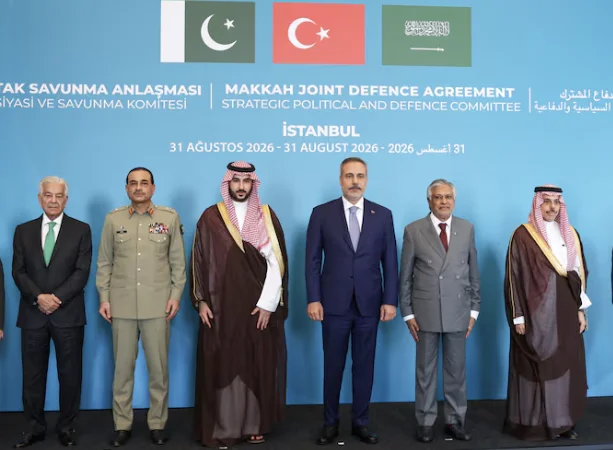
Saudi Arabia, Turkey and Pakistan have agreed to establish a permanent secretariat to coordinate their newly formed joint defence partnership, marking an important step towards turning their political agreement into an operational framework.
The decision was announced after the first meeting of the Strategic Political and Defence Committee in Istanbul on Monday. The meeting brought together foreign and defence ministers as well as senior military officials from the three countries.
Secretariat to Be Based in Saudi Arabia
The new secretariat will be based in Saudi Arabia, according to a joint statement issued by the three countries.
Turkish Foreign Minister Hakan Fidan said the first secretary-general would come from Pakistan and would serve an initial three-year term.
The secretariat is expected to provide an institutional mechanism for coordinating defence cooperation, organising meetings and helping implement decisions taken under the agreement.
Makkah Joint Defence Agreement
Saudi Arabia, Pakistan and Turkey signed the Makkah Joint Defence Agreement on August 7.
The agreement states that an armed attack against any one of the three countries would be treated as an attack against all three, creating a framework for mutual defence.
However, the agreement has not publicly specified all the circumstances under which military assistance would be triggered or how the mutual-defence provision would operate in practice.
Building Military Cooperation
The first committee meeting focused on developing practical mechanisms for cooperation among the three countries.
The agenda included military interoperability, joint exercises, defence-industrial cooperation, joint production, research and development, and counterterrorism coordination.
The establishment of a permanent secretariat is intended to give these areas of cooperation a more structured and continuous framework.
Comparisons With NATO
The mutual-defence provision has prompted comparisons with Article 5 of the NATO treaty.
However, analysts have cautioned against treating the new arrangement as equivalent to NATO. The three-country pact does not currently have NATO-style integrated command structures, standing forces or a permanent joint military apparatus.
The secretariat is therefore an important institutional step, but it does not by itself create a NATO-style military alliance.
Pact Faces Its First Major Test
The Istanbul meeting took place amid renewed military escalation between the United States and Iran.
After a month-long lull, the two sides resumed hostilities. The United States struck Iranian rocket launchers on Larak Island, while Iran subsequently claimed attacks on US military facilities in the region.
The renewed conflict provides an immediate test of how the new Saudi-Turkish-Pakistani security framework will operate during a regional crisis.
Pakistan Takes the First Leadership Role
Pakistan's selection to provide the first secretary-general gives Islamabad an important institutional role within the new arrangement.
Pakistan also maintains a significant defence relationship with Saudi Arabia while seeking to preserve diplomatic channels with Iran.
Balancing these relationships could become increasingly important if the new defence framework develops into a more active regional security mechanism.
Possibility of Expansion
The three countries have indicated that the framework could eventually be opened to additional members.
Bangladesh has publicly signalled that it is considering joining the pact. Egypt has also participated in earlier regional security discussions involving Saudi Arabia, Turkey and Pakistan.
Turkish President Recep Tayyip Erdogan has also indicated that the framework could eventually expand beyond its three founding members.
Potential Impact on Regional Security
Saudi Arabia, Turkey and Pakistan each occupy strategically important positions in their respective regions.
Closer defence cooperation could lead to greater collaboration in military training, defence technology, intelligence sharing, joint exercises and defence production.
The key question, however, is whether the arrangement develops into a broad regional security partnership or becomes increasingly associated with countering Iran. Analysts say that distinction could determine its long-term strategic significance.
Conclusion
Saudi Arabia, Turkey and Pakistan have agreed to establish a permanent secretariat in Saudi Arabia under their Makkah Joint Defence Agreement, with Pakistan providing the first secretary-general for a three-year term.
The move gives the trilateral defence pact a formal institutional structure and could strengthen cooperation in military exercises, defence production, research and operational coordination.
But the agreement's real significance will depend on how its mutual-defence commitment works during an actual crisis and whether the three countries can maintain a common strategic position amid growing tensions across the Middle East.