


The conflict between the United States and Iran has entered a new and potentially dangerous phase after Tehran launched retaliatory attacks against US military positions in Jordan, prompting President Donald Trump to threaten a forceful response.
The latest escalation began after US forces struck two Iranian rocket launchers on Larak Island, located in the Strait of Hormuz. Washington said the launchers posed an imminent threat because they were allegedly being prepared to fire weapons capable of deploying naval mines in the strategic waterway.
Iran retaliates against US bases in Jordan
Iran's Islamic Revolutionary Guard Corps said it launched a combined missile and drone operation against US bases in Jordan.
The IRGC described the attack as retaliation for the US strikes on Larak Island, which Iranian officials said caused casualties among Iranian military personnel and civilians.
Jordan's military, however, said its air defence systems intercepted eight missiles that entered the country's airspace. No injuries were initially reported at the targeted bases.
Iran has described its military response as an act of self-defence, while Washington has defended its Larak operation as a limited strike intended to protect shipping and civilian vessels in the Strait of Hormuz.
Trump warns: ‘We’re going to hit them hard’
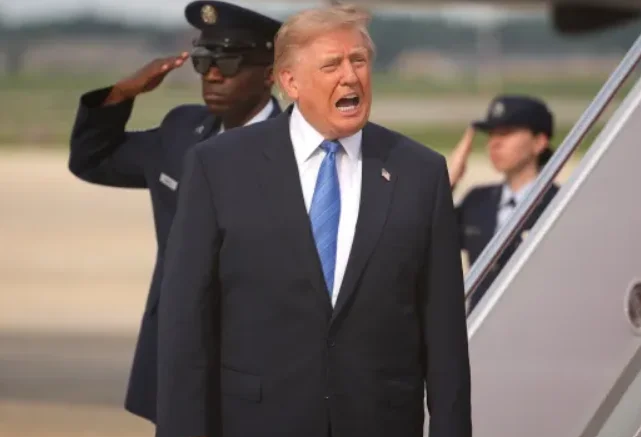
Following the Iranian retaliation, Trump issued a stark warning to Tehran.
Speaking to Fox News, the US president said: “We’re going to hit them hard”, indicating that Washington was preparing a response to the latest Iranian strikes.
Trump also described Iran as a “failed nation” in a social media post and repeated his criticism of the Iranian leadership.
The latest threats raise concerns that the renewed confrontation could develop into a wider regional conflict, particularly after weeks of diplomatic efforts aimed at reducing tensions.
UAE also drawn into the escalation
The confrontation has not been limited to Iran, the US and Jordan.
Iranian authorities said they also targeted US military assets at the Al Menhad airbase in the United Arab Emirates using drones.
The UAE, however, rejected reports that its airbase had been attacked. Its Defence Ministry said its forces intercepted a drone approaching from Iran over UAE territorial waters.
The UAE has called for de-escalation and warned against attacks targeting Gulf states and Jordan.
Strait of Hormuz becomes a major flashpoint
The latest confrontation has also intensified concerns over the Strait of Hormuz, one of the world's most important energy routes.
The United States said the Larak Island launchers were connected to a potential threat involving naval mines in the waterway. Iran, meanwhile, has repeatedly demonstrated its ability to disrupt shipping routes in the region.
Oil prices rose following the latest US-Iran escalation, reflecting renewed concerns about disruptions to global energy supplies.
Diplomatic efforts face fresh setback
The renewed fighting comes despite recent attempts by mediators including Oman, Pakistan and Qatar to restart negotiations between Washington and Tehran.
The latest exchange of attacks could make those diplomatic efforts more difficult and increase the risk of further military escalation.
For now, the situation remains fluid, with the possibility of additional US action following Trump's warning. The coming hours are expected to be closely watched for signs of whether the latest confrontation remains limited or develops into a broader regional escalation.