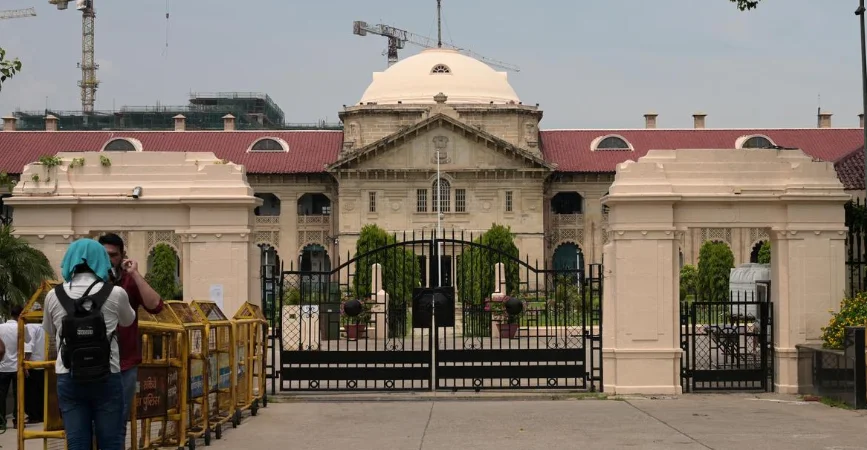
The Allahabad High Court has set aside the preventive detention of Aakriti Chaudhary, a 25-year-old Delhi University history graduate, under the National Security Act (NSA) in a case linked to the Noida workers’ protest.
A Bench comprising Justices Atul Sreedharan and Achal Sachdev allowed Chaudhary’s habeas corpus petition challenging her continued detention. The court directed her release if she was not required in any other case and also ordered compensation of ₹5 lakh, according to reports on the judgment.
The court’s decision came after it closely examined the circumstances surrounding Chaudhary’s arrest and the subsequent invocation of the NSA.
Court questions arrest sequence
During the proceedings, the State told the court that Chaudhary had been arrested at around 10:56 a.m. on April 12, 2026, and that a notice under Section 130 of the Bharatiya Nagarik Suraksha Sanhita (BNSS) had been issued.
The State alleged that Chaudhary had encouraged protesters to engage in stone-pelting and arson.
The Bench, however, questioned whether the required procedural steps had been followed. The judges noted that no notice under Section 126 of the BNSS had been served before the Section 130 notice.
The court also examined the General Diary entry and questioned the State’s account after finding that the records appeared to indicate that Chaudhary had already been arrested before the notice was prepared.
Evidence of alleged instigation questioned
The court had earlier sought specific evidence showing Chaudhary allegedly instigating protesters to throw stones or set vehicles on fire.
The State referred to witness statements and claimed that electronic and video evidence existed. However, the Bench repeatedly questioned whether there was footage directly showing Chaudhary encouraging protesters to engage in violence.
The judges also examined the chronology of the protest and Chaudhary’s arrest while assessing the State’s claim about her alleged role in the violence.
Ultimately, the Bench concluded that the detention was based on what it described as a “concocted story” by the State. A detailed written order is awaited.
Five months in custody
Chaudhary had spent around five months in custody in connection with cases arising from the Noida workers’ agitation.
The protests in April involved industrial workers demanding better wages and working conditions. The demonstrations later turned violent, resulting in widespread arrests and multiple criminal cases.
The Uttar Pradesh Police subsequently invoked the NSA against Chaudhary and activist-journalist Satyam Verma on May 13.
Police had alleged that the two played a significant role in instigating violence and disrupting public order. Chaudhary, however, maintained that she had attended the workers’ demonstration as a social worker and was not an organiser of the protest.
Release order does not automatically end other cases
Although the High Court has quashed the NSA detention, Chaudhary may continue to remain in custody until she secures bail in the other criminal cases registered against her in connection with the protest.
The court’s order specifically provides for her release if she is not required in any other case.
The ruling has drawn attention to the limits of preventive detention powers and the importance of following due procedure when stringent laws such as the NSA are invoked.