


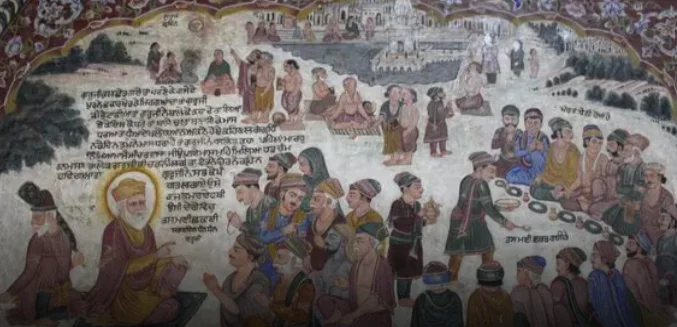
The Golden Temple, one of Sikhism’s most revered sites, is known not only for its spiritual significance but also for its remarkable artistic heritage. Among its lesser-known treasures are the historic frescoes and painted ceilings that preserve stories, motifs and artistic traditions from the Sikh past.
Many of these artworks date back to the 19th century, a period when fresco painting flourished across Punjab. Artists decorated religious buildings with intricate patterns, floral designs, portraits and scenes inspired by Sikh history and religious traditions.
The painted ceilings and walls provide an important visual record of the artistic culture that developed around Sikh religious institutions. Their intricate detailing reflects the craftsmanship of artists who worked with traditional techniques and natural pigments.
A Window Into Sikh Artistic Tradition
The frescoes are more than decorative works. They represent a visual language through which stories, religious beliefs and historical memories were preserved.
The artworks feature a combination of floral motifs, geometric patterns, human figures and narrative scenes, reflecting influences from different artistic traditions that existed in the Punjab region.
The Golden Temple complex therefore serves not only as a place of worship but also as an important repository of Sikh art and cultural heritage.
The Impact of Partition
The artistic traditions associated with these frescoes were disrupted by the Partition of India in 1947. The division of Punjab resulted in the movement of communities and artists across newly created borders, affecting the continuity of several traditional art practices.
Over time, many historic frescoes across Punjab faced challenges from neglect, environmental damage and changing architectural practices. Conservation efforts have therefore become increasingly important to preserve these fragile works for future generations.
Preserving a Cultural Legacy
Conservation of historic Sikh frescoes requires careful restoration because inappropriate repairs or modern materials can permanently damage the original artwork.
Art historians and conservation specialists continue to study surviving examples to understand the techniques, materials and themes used by earlier generations of artists.
The painted ceilings of the Golden Temple offer a rare opportunity to understand how religion, art and history came together in Punjab, making them an important part of the region’s cultural legacy.