



Why Re-entry Is One of the Biggest Challenges
Sending astronauts into space is only one part of a human spaceflight mission.
Bringing them safely back to Earth presents another major engineering challenge.
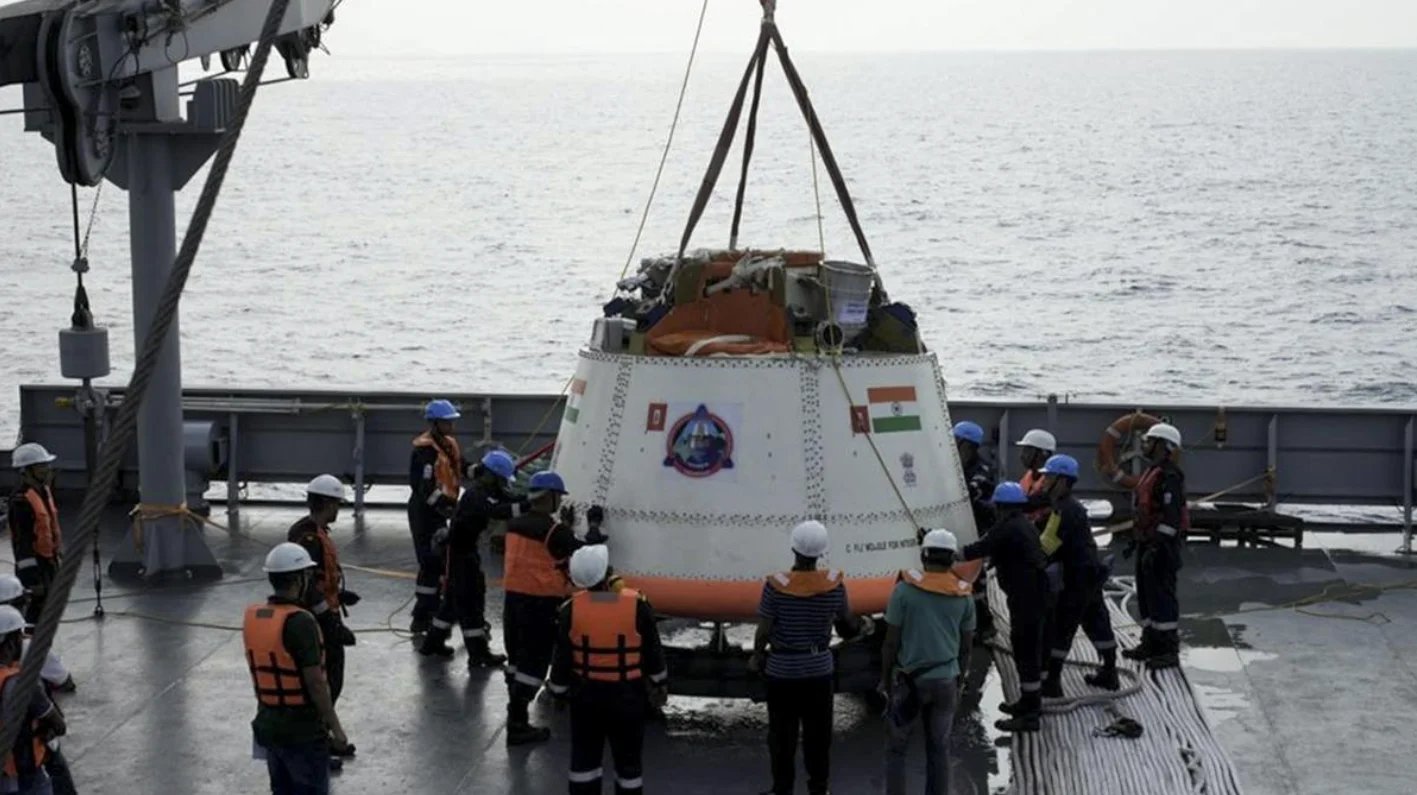
After completing its mission in orbit, the Gaganyaan crew module will begin its journey back to Earth. As it enters the atmosphere at very high speed, it will encounter rapidly increasing atmospheric resistance and extreme heating.
The spacecraft must withstand these conditions while maintaining a safe environment for the astronauts inside.
What Is a Thermal Protection System?
A thermal protection system is designed to protect a spacecraft and its occupants from the intense heat generated during atmospheric re-entry.
For Gaganyaan, the heat shield will form one of the most important components of this system.
The shield is designed to withstand the extreme thermal environment outside the spacecraft while limiting the amount of heat transferred into the crew compartment.
Where Does the Re-entry Heat Come From?
Re-entry heating is often described simply as the result of friction between the spacecraft and the atmosphere.
The actual process is more complex.
At very high speeds, the air in front of the spacecraft becomes compressed intensely. This compression causes the temperature of the surrounding gas to rise dramatically.
The resulting high-temperature flow around the spacecraft creates an extremely demanding thermal environment.
How Does a Heat Shield Work?
The heat shield uses materials specifically designed to withstand extreme temperatures.
Some thermal protection systems rely on materials that gradually undergo controlled physical and chemical changes when exposed to intense heat.
This process can remove or carry away a significant amount of thermal energy before it reaches the spacecraft's interior.
The Role of Ablative Protection
One important approach is known as ablative thermal protection.
An ablative material gradually loses material from its exposed surface as it experiences extreme heating.
As the material changes and releases energy, it helps prevent excessive heat from reaching the underlying structure.
In simple terms, part of the heat-shield material is deliberately sacrificed to protect the spacecraft and its occupants.
Why Re-entry Angle Matters
The heat shield cannot work alone.
The angle at which the spacecraft enters the atmosphere is also critical.
If the entry is too steep, the spacecraft can experience excessive heating and deceleration.
If the angle is too shallow, the spacecraft may not lose enough energy in the atmosphere and could potentially skip back into a higher trajectory.
A carefully controlled re-entry path is therefore essential for a safe return.
Slowing Down the Spacecraft
The crew module will return to Earth at extremely high speed.
As it moves through the atmosphere, aerodynamic resistance gradually reduces its velocity.
A large amount of the spacecraft's kinetic energy is converted into heat during this process.
The spacecraft's shape is therefore an important part of the thermal protection strategy.
Importance of the Crew Module's Shape
The re-entry module is designed with a shape that manages the airflow around the spacecraft.
Its forward-facing surface encounters the strongest aerodynamic effects during atmospheric entry.
The shape helps control the flow of extremely hot gases around the vehicle while also producing the aerodynamic forces required to slow the spacecraft.
Protecting the Crew Compartment
While the outside of the spacecraft experiences extreme heating, conditions inside the crew compartment must remain within safe limits.
The heat shield works together with insulation and the spacecraft's internal structure to reduce heat transfer.
Maintaining acceptable internal temperatures is essential for astronaut safety.
Testing Is Critical for Gaganyaan
For a human spaceflight programme, thermal protection cannot simply be assumed to work based on computer models.
Engineers use simulations, ground tests and flight demonstrations to assess how the system behaves under extreme conditions.
The thermal protection system must be evaluated carefully before astronauts are placed inside the spacecraft.
Re-entry Is Not the End of the Mission
Even after the crew module has passed through the hottest phase of atmospheric entry, the mission still has several critical stages remaining.
The spacecraft must continue slowing down and eventually deploy its parachute system.
The entire sequence must work correctly so that the crew module can make a controlled descent and safe landing or splashdown.
Thermal protection is therefore one part of a much larger chain of systems required for a successful crew recovery.
India's Human Spaceflight Ambition
Gaganyaan represents India's effort to develop the capability to send humans into space and safely return them to Earth.
The thermal protection system is central to that objective because a human-rated spacecraft must be capable of surviving not only launch and orbital operations but also the intense conditions of atmospheric re-entry.
The successful development and testing of these technologies will contribute to India's broader human spaceflight capabilities.
Conclusion
The thermal protection system will be critical to the safe return of Gaganyaan astronauts.
The spacecraft's heat shield, specialised materials, aerodynamic design, insulation and carefully controlled re-entry trajectory will work together to withstand the extreme environment encountered during atmospheric entry.
Successfully managing this phase will be essential to India's goal of safely bringing astronauts back to Earth and demonstrating the country's growing human spaceflight capabilities.