


Rajiv Link Canal Suffers Fresh Damage
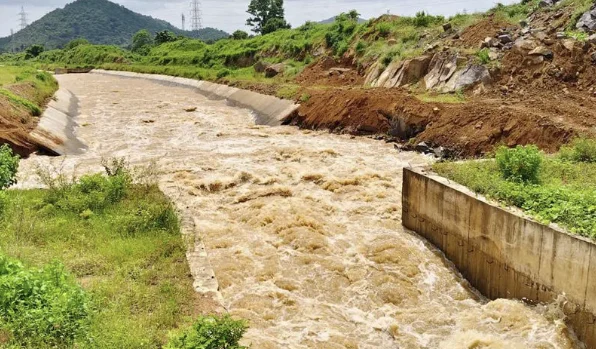
The Sitarama Project's Rajiv Link Canal in Bhadradri Kothagudem district has suffered another setback, with a section of its reinforced cement concrete side-lining damaged for the second time within a week.
Around 6–7 metres of RCC lining was washed away at Vinobha Nagar in Julurupadu mandal, exposing the soil embankment beneath the canal.
The latest damage has raised fresh questions about the quality and durability of the canal works.
Damage Reported After Water Release
The latest damage occurred after water was released into the canal.
With water continuing to flow through the damaged section, local farmers are concerned that the exposed soil could undergo further erosion.
If the erosion expands, the damaged portion could potentially develop into a larger breach.
Second Incident Within a Week
The latest incident comes only days after another section of the canal's RCC side-lining was damaged between Repallewada and Imamnagar in Enkoor mandal of Khammam district.
In that incident, part of the concrete lining disintegrated and exposed the earth beneath it.
Officials reportedly stopped the flow of water and carried out repairs to the damaged section.
The recurrence of similar damage at another location has intensified concerns over the overall quality of the canal construction.
Nine-Kilometre Link Canal
The Rajiv Link Canal connects the Sitarama Project's main canal in Julurupadu mandal with the Nagarjuna Sagar Project canal near Enkoor.
The link canal is approximately nine kilometres long.
Its purpose is to help divert Godavari water towards agricultural lands under the Nagarjuna Sagar Project ayacut in Khammam district.
Project Cost and Construction Speed
The link canal was constructed at an estimated cost of around ₹72 crore.
The project was completed in a relatively short period, with construction reportedly taking around four months.
While the quick completion was seen as significant at the time, repeated damage to the canal lining has now raised questions about whether adequate attention was given to construction quality and long-term durability.
Farmers Raise Quality Concerns
Local farmers have raised concerns that quality standards may not have been adequately maintained during construction.
They point to the repeated failure of the RCC lining soon after water began flowing through the canal as a reason for questioning the workmanship.
The latest incident has added to demands for a detailed technical assessment rather than temporary repairs alone.
Risk of Further Erosion
The exposed soil beneath the damaged concrete lining remains a major concern.
Continuous water flow can increase erosion if the affected section is not properly protected.
Farmers fear that a larger breach could eventually disrupt irrigation and potentially affect nearby agricultural land.
Importance for Irrigation
The Sitarama Lift Irrigation Project is intended to use Godavari water to provide irrigation to agricultural areas across parts of Bhadradri Kothagudem, Khammam and Mahabubabad districts.
The Rajiv Link Canal is an important part of the plan to connect the project with the Nagarjuna Sagar irrigation network.
Any prolonged disruption to the link canal could therefore affect the intended supply of irrigation water.
Need for Technical Investigation
The repeated failure of canal lining at different locations within a short period suggests that the problem needs to be examined beyond individual damaged sections.
Engineers and independent technical experts may need to assess the concrete quality, embankment strength, water-flow conditions, drainage arrangements and construction methods.
Such an assessment could help determine whether the damage is isolated or reflects a wider structural issue.
Temporary Repairs May Not Be Enough
Repairing the visible damage is an immediate requirement, but long-term safety will depend on identifying the underlying cause.
If the problem is linked to construction quality, simply restoring the damaged concrete may not prevent similar failures elsewhere.
A comprehensive inspection of the canal could help identify vulnerable sections before they suffer damage.
Accountability and Quality Control
Large irrigation projects involve substantial public investment and require strict quality control.
Contractors, engineers and supervising authorities all have a role in ensuring that construction standards are followed.
Where defects are identified, responsibility needs to be established and corrective measures should address the root cause rather than only the visible damage.
Challenge for Authorities
The immediate challenge is to protect the damaged section while water continues to move through the canal.
At the same time, authorities will need to assess whether other stretches of the link canal are vulnerable to similar damage.
Ensuring the safety and reliability of the canal will be important for maintaining irrigation supplies to farmers who depend on the project.
Conclusion
The second instance of damage to the Sitarama Project's Rajiv Link Canal within a week has intensified concerns about construction quality in the project.
The 6–7 metre stretch of RCC lining washed away at Julurupadu, exposing the soil beneath, has raised fears of further erosion while water continues to flow.
Authorities will need to go beyond temporary repairs and conduct a comprehensive technical assessment of the canal to identify the underlying causes and prevent similar failures in the future.