


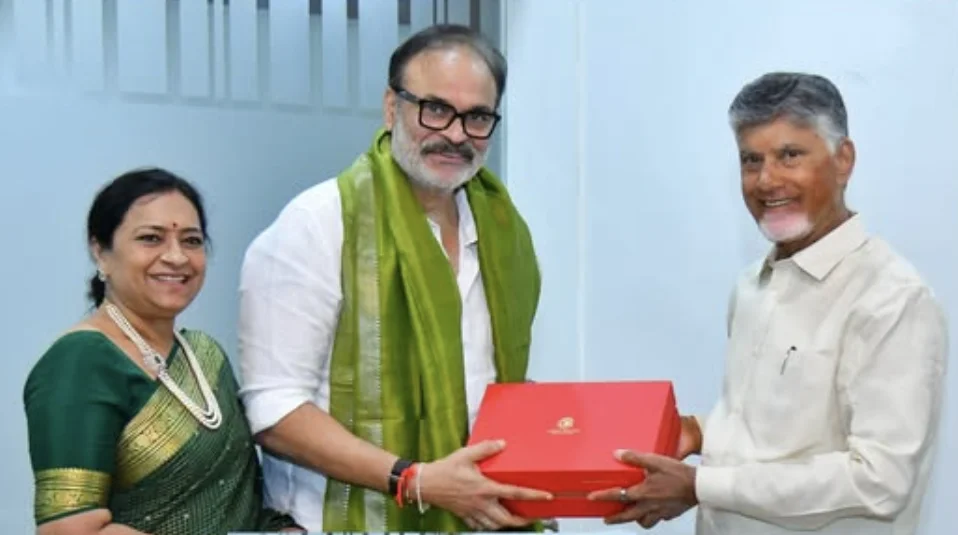
Jana Sena MLC Konidela Nagababu has formally taken charge as Chairman of the Executive Committee of the Andhra Pradesh Society for Greening and Reforestation for Ecological Enrichment (AP GREEN).
Nagababu assumed office on Friday at Aranya Bhavan in Mangalagiri, where he participated in a formal ceremony along with his wife Padmaja. Special prayers were conducted in the presence of Vedic scholars before he took charge of the post.
The appointment gives Nagababu a key role in one of the Andhra Pradesh government's major long-term environmental initiatives.
The AP GREEN programme has been established to expand forest and tree cover, promote reforestation and strengthen environmental conservation across the state.
Its most ambitious target is to increase the combined forest and tree cover of Andhra Pradesh to 50% of the state's geographical area by 2047.
The state government formally appointed Nagababu to head the executive committee through an order issued on August 17, 2026.
The government also accorded cabinet rank to the position of AP GREEN Executive Committee Chairman.
Speaking after taking charge, Nagababu said he regarded the responsibility as both an honour and a major obligation.
He thanked Chief Minister N. Chandrababu Naidu and Deputy Chief Minister Pawan Kalyan for placing their trust in him and assigning him the responsibility.
Nagababu said he would work with full commitment to achieve the objectives set by the AP GREEN Society.
He stressed that the government's green programme should not focus merely on planting trees.
The survival and long-term growth of planted trees must also receive special attention, he said.
This approach places emphasis not only on plantation drives but also on maintenance, protection and monitoring of trees after they are planted.
Nagababu also said he would coordinate with different government departments to achieve the state's environmental goals.
The AP GREEN programme has been designed as a multi-departmental initiative rather than a project limited to the Forest Department.
The government's framework brings together departments including forests, finance, panchayat raj, agriculture, tribal welfare, education, industries, revenue, water resources and roads and buildings.
The state has also planned a governance structure involving a governing board, an executive committee and district-level green development bodies.
The objective is to ensure that the programme is implemented across Andhra Pradesh and that progress can be monitored at different administrative levels.
The 2047 target represents a long-term effort to expand the state's green cover.
Achieving such a target will require sustained plantation activity as well as protection of existing forests and vegetation.
It will also require coordination between government agencies, local institutions and communities.
Nagababu's initial remarks suggest that the programme will place particular emphasis on the survival of newly planted trees.
This is significant because plantation numbers alone do not necessarily translate into permanent increases in green cover.
Trees must survive and mature for their ecological benefits to be realised.
The programme is expected to focus on several areas, including afforestation, reforestation, tree plantation and environmental conservation.
Protecting existing forest areas will also remain important if the state is to achieve a substantial increase in overall green cover.
Deputy Chief Minister Pawan Kalyan congratulated Nagababu after he assumed charge.
Pawan said he hoped Nagababu would effectively implement the AP GREEN vision and contribute to the target of covering 50% of the state's geographical area with green cover by 2047.
The government has described the initiative as part of its broader Viksit Andhra Pradesh-2047 vision.
The objective is not simply to increase the number of trees but to create a broader environmental conservation framework across the state.
Nagababu's appointment comes with an administrative structure already being put in place.
The government has created a governing board for AP GREEN, with senior officials from several departments included in the framework.
District-level green development bodies are also being established to support implementation at the local level.
Several senior forest and government officials met Nagababu after he took charge.
Among those who congratulated him were Principal Chief Conservator of Forests P.V. Chalapathi Rao, Additional PCCF Rahul Pandey, Forest Department Adviser Mallikarjuna Rao and other senior officials.
The AP GREEN Chief Executive Officer B.N.N. Murthy and Panchayat Raj Commissioner Krishna Teja were also among those associated with the programme.
The involvement of multiple departments is expected to be important because increasing green cover requires action beyond forest management.
Agriculture, rural development, water management, urban planning and local governance can all influence the state's environmental footprint.
Public participation is another important component.
Nagababu has indicated that people should be made partners in environmental conservation.
A broader public movement around tree protection and environmental awareness could help improve the survival rate of plantations and strengthen local conservation efforts.
The challenge, however, will be translating the 2047 vision into measurable annual targets.
Plantation programmes need to be accompanied by monitoring systems that can track survival rates and changes in forest and tree cover.
Local ecological conditions also need to be considered when selecting tree species and planning plantation areas.
Water availability, soil conditions and long-term maintenance will influence whether newly planted trees survive.
This makes the implementation phase as important as the target itself.
The government has created the AP GREEN institutional framework with the intention of coordinating these efforts across the state.
Nagababu, as executive committee chairman, will be expected to coordinate implementation and monitor progress towards the programme's objectives.
The cabinet-rank status attached to the position also reflects the importance the state government has placed on the initiative.
For Nagababu, the immediate challenge will be converting the broad 2047 target into concrete programmes and measurable outcomes.
The success of the initiative will ultimately be judged not only by the number of saplings planted but by how much additional forest and tree cover survives and develops over the years.
The environmental benefits could extend beyond the simple expansion of tree cover.
Greater vegetation can contribute to soil conservation, biodiversity protection, water retention and broader ecological resilience.
At the same time, protecting existing forests will be essential because new plantations cannot fully substitute for mature natural forests.
The programme therefore faces a dual challenge: protect what already exists while creating additional green cover.
Nagababu's emphasis on tree survival indicates that the administration is aware of this distinction.
His coordination role will also require cooperation between state departments and district-level institutions.
The government has already created mechanisms for such coordination, but their effectiveness will depend on implementation on the ground.
For Andhra Pradesh, the 2047 target is ambitious.
Reaching 50% green cover will require sustained effort over more than two decades.
It will also require continuous monitoring to ensure that gains in green cover are maintained rather than lost through deforestation, development pressures or inadequate maintenance.
Nagababu's assumption of office marks the beginning of his formal role in that effort.
He has said that he will work with sincerity to fulfil the objectives entrusted to him and coordinate with all departments to achieve the state's environmental goals.
The coming years will show how effectively the AP GREEN framework can translate policy goals into measurable environmental improvements.
For now, the government has set a clear long-term benchmark: 50% forest and tree cover across Andhra Pradesh by 2047.
With Nagababu now heading the executive committee, the focus will shift towards implementation, coordination, plantation, conservation and monitoring.
The programme's success will depend on whether these efforts result in lasting increases in green cover and stronger environmental protection across the state.
Nagababu's assumption of charge therefore marks an important administrative step in Andhra Pradesh's long-term green agenda, with the 2047 50% green-cover target now at the centre of his new responsibility.