


Spend any time in an Ayurvedic kitchen, or indeed in my clinic, and you will notice that ghee is never spoken of as just another cooking fat. It is treated with a quiet sort of reverence that few other ingredients receive, and rightly so. In Ayurveda, ghee is food, medicine and a steady workhorse all at once. Knowing its different forms helps you use it far more sensibly than simply spooning it over your rice and leaving it at that.
This article sets out what Ayurvedic ghee actually is, the main types you are likely to encounter, and how each has traditionally been used. Wherever a Sanskrit term appears, I have explained it in plain English alongside, so nothing gets lost along the way.
TL;DR – Ayurvedic Ghee, Types & Uses
- Ghee Is More Than Cooking Fat: Ayurveda views ghee, or Ghrita, as food, nourishment, and a carrier for herbs that may support deeper tissue delivery.
- Regular and Medicated Ghee Are Different: Cow ghee is used in daily cooking, while medicated ghritas like Brahmi Ghrita, Triphala Ghrita, Phal Ghrit, and Ashwagandha Ghee are used for specific traditional purposes.
- Different Ghritas Serve Different Needs: Brahmi Ghrita supports mind and memory, Triphala Ghrita is linked with digestion and eye-care traditions, Phal Ghrit with reproductive wellness, and Ashwagandha Ghee with strength and vitality.
- Use Depends on Agni and Health Condition: Ghee should be taken in sensible amounts based on digestion, body type, purpose, and overall fat tolerance.
- Medicated Ghrita Needs Guidance: High doses or therapeutic use should not be self-prescribed, especially in pregnancy, children, chronic illness, medication use, fatty liver, poor fat absorption, gallbladder issues, or high cholesterol.
What Is Ayurvedic Ghee?
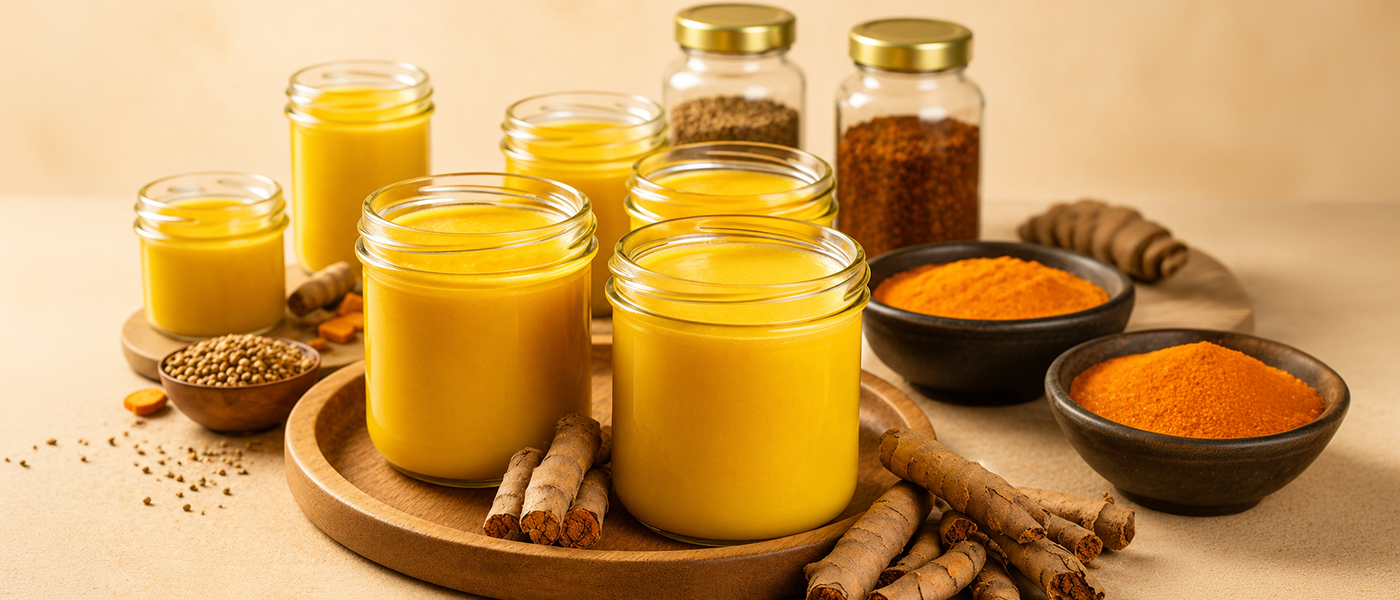
Clarified butter, or ayurvedic ghee, is butter in which the water and milk solids are gently heated out, leaving a pure gold coloured fat. This ghrita, as called by Ayurveda, has multiple uses. It is eaten as part of the daily diet, used as a cooking medium, applied in certain traditional massage practices, and, perhaps most interestingly, used as a carrier base for herbal preparations.
Herbs cooked in ghee is called a medicated ghrita. This is not the same with the pot in your kitchen. As a medicated ghrita is more of a medicine than a food and therefore requires more care, preferably from a practitioner; it is closer to an Ayurvedic medicine than a food.
The use of ghee in Ayurveda dates back long time. It is listed in the classical text Caraka Samhita, as one of the 11 foods prescribed for daily consumption, Nityasevaniya Ahaara. It's not too much to say that's a pretty big endorsement. It is telling us that ghee was considered adequate to take on a daily basis without any adverse effect. This is reflected in its many Sanskrit names, pavitra, pure; ajya, long-lasting; amrita, the nectar of life; and tejas, brightness or potency.
The smooth, unctuous quality of ghee is known in Ayurveda as unctuous and helps to promote the increase of rasa (body nourishing fluids), which helps in easing the passage of nutrients and waste. Being a fat, it also increases kapha, one of the three doshas, or basic energies Ayurveda uses to describe constitution and function. This may seem like a disadvantage, but it can actually help develop the refined essence of immunity and vitality, known as ojas. Ghee stimulates digestion and the digestive fire (agni).
To sum up ghee is clarified butter (ghrita) as described in Ayurvedic texts and is applied as regular food and to herbal formulations. It is used as a vehicle to transport herbs to deeper tissue levels, and medicated ghrita should be used carefully, and possibly professionally, as opposed to unmedicated dietary ghee.
Main Types of Ayurvedic Ghee
There is no single "Ayurvedic ghee. In fact, ghee comes in a variety of types, from regular cow ghee that's used in cooking to specialized, medicinal ghee marinated with herbs for specific applications.
|
Type of Ayurvedic Ghee |
Common Traditional Use |
|
Cow ghee |
Daily cooking, Ayurvedic diet, general nourishment |
|
Brahmi Ghrita |
Mind, memory, focus, nervous-system support |
|
Triphala Ghrita |
Digestion, bowel regularity, eye-health traditions |
|
Phal Ghrit |
Traditionally associated with reproductive wellness |
|
Ashwagandha Ghee |
Strength, stress support, vitality, nourishment |
In addition to these, there are several other Ghritas described in classical Ayurveda for specific uses, e.g. Kalyanak Ghrita to improve mental health and Jatyadi Ghrita which is applied topically for wound healing. There is some study on Brahmi Ghrita combined with yoga practice that suggests improvement in learning, attention, processing speed and working memory in elderly people with mild cognitive impairment. Such discoveries indicate that ghee used as a base for herbs can enhance the bioavailability and utilization of herbs, which is cited in Ayurveda as yogavahi or "that which carries a substance or property that acts as a catalyst or intelligent carrier. It enhances the therapeutic effects of other medicines and transports them deep into the body's tissues without altering its own core properties.
Let us look at each type in turn.
1. Organic Cow Ghee
The most commonly known kind of ghee in Ayurveda is cow ghee, and it is used in daily cooking routine and in traditional food habits in most homes of India. It still contains a fair amount of fat and a high calorie count, though, and shouldn't be eaten excessively.
The Sanskrit word for ghee is ghrita, which translates to "to shine. According to ayurveda, ghee is something which illuminates body and mind with their own radiance and promotes dhi (intelligence), buddhi (intellect) and smrti (memory). It is also believed to be soft and oily and softens the organs and renders the mind flexible and comfortable.
Apart from these, ghee has also been a part of the cleansing rituals for quite some time, and is a part of the traditional purification rituals known as panchakarma. Many of the toxins found in the body are fat-loving (lipophilic) and can easily attach to ghee, which helps to eliminate toxins from the tissues.
Pure cow ghee is naturally rich in vitamins like Vitamin A, which is beneficial for skin, eyes and immunity and has a high smoke point which makes it ideal for daily cooking purposes, from tempering dal to adding a little to warm bowls of rice.
Ghee is a good example of a yogavahi or a catalyst, which is able to penetrate deep into the tissues, carrying with it the beneficial properties of herbs, and is often preferred in Ayurveda. Oils that have been refined, on the other hand, are processed extensively and lose a lot of their healthy properties. Traditional ghee, prepared properly, nourishes Agni, balances all three doshas – Vata, Pitta and Kapha, and nourishes the nervous system.
Check Out Organic Cow Ghee vs Regular Ghee: Which One Truly Nourishes You?-->
2. Brahmi Ghrita
Brahmi Ghrita is a medicated ghee, not a ghee spread on toast. It is prepared by cooking Brahmi and a set of supporting herbs into ghee, and is traditionally associated with the mind, memory, learning, focus and nervous-system support. In classical Ayurvedic classification it falls under Medhya Rasayana, a category of formulations meant to support mental clarity and intellect over time.
Brahmi Ghrita Benefits and Uses
Traditionally, Brahmi Ghrita has been used in some health disorders as described in classical literature (Unmada and Apasmar—seizure related condition) and has long been associated with memory and concentration. It is also used as part of a preparatory procedure (snehakarma) to be performed prior to some cleansing therapies, and is associated with learning ability, intelligence, speech, and even in classical texts, skin health and some reproductive issues.
Some traditional applications include easing low mood, tiredness and low mood discomfort, and occasional panic-like feelings. It is associated with Kapha, Pitta and Vata and is thus generally considered calming for both children and elderly people; should not be used by people with fatty liver, jaundice or poor fat absorption.
The traditional method of preparation is to extract the juice from the fresh Brahmi leaves, and make a paste of a pre-mixed combination of five to six herbs such as Pippali (long pepper), Krimihara (fruits of Acacia fumosoriana), and so on; then slowly cook the paste with Brahmi juice, ghee, etc., till the moisture is reduced and the consistency is reached. It's a meticulous process, hence the classical ghritas are considered as special preparations to regular cooking fats.
The recommended dose according to traditional sources is 10 grams, twice a day, although this varies from person to person depending on their digestive power and health condition and should be checked by a qualified physician. Brahmi Ghrita is best given with practitioner supervision, especially in children, pregnant females, when used with other medicines or illnesses.
3. Triphala Ghrita
Another medicated ghee is Triphala Ghrita made from the popular trio of fruits known as Triphala in Ayurvedic medicine. It is known to be related to digestion, bowel regularity, gut support and a long history of eye-care use. It is important to note that the Triphala Ghrita is not the same as Triphala powder as the latter is used in a completely different manner.
Triphala Ghrita Benefits and Uses
Triphala Ghrita is routinely given for eye comfort (to improve vision), for itching and for general eye discomfort and is also linked with hair health, immunity and excess Pitta related ailments. It is said that when taken internally, it can help balance aggravated Vata and Pitta. Some practitioners also suggest using a little to treat the eyelids every day in the morning and evening as part of an eye-care program.
According to the traditional view, Triphala Ghrita is Rasayana, and is the body, promote immunity, and thus gives resistance. When applied topically, it is claimed to remove impurities and dryness from the scalp, thereby promoting healthy hair growth.
It is naturally lipid rich and has a mucoadhesive property which is of great benefit to stay in the eye for a longer period, say for more than fifteen minutes during the traditional procedure called Netra Tarpana. The extended contact time is believed to be helpful because it increases the effectiveness of the treatment, and it is said to stimulate the eye's natural tear glands, providing relief to people with moderate to severe dryness. Like all ghee preparations, it is advisable to consume it in proper dosages, as some may find it to be too heavy, and an extended period of consumption should be advised by a practitioner.
Check Out Triphala Ghrita: The Ayurvedic Ghee for Gut, Eyes, and Rejuvenation–>
4. Phal Ghrit (Phala Ghrita)
Phal Ghrit, also known as Phala Ghrita, is a classical medicated ghee traditionally associated with reproductive wellness. It is built from an elaborate list of herbs, including Manjistha, Kustha, Tagar, Haritaki, Bibhitaka, Amalaki, Vacha, Haridra, Daruharidra, Madhuka, Meda, Katurohini, Kakoli, Ashwagandha, Shatavari and Hing, brought together with jaggery, cow's ghee and cow's milk. This is firmly a medicated formulation rather than a dietary ghee, and should be used only with proper guidance, particularly where fertility, pregnancy or hormonal balance are concerned.
Phala Ghrita has traditionally been described as prajasthapaka, associated with supporting conditions favourable to conception. Some clinical observations suggest it may support ovarian function, encourage healthy follicular development and strengthen the uterine lining, all of which can improve the conditions for conception. In documented studies, close to twenty-two per cent of women dealing with infertility conceived after three months of taking Phala Ghrita by orally, particularly where no specific structural cause was identified. Its blend of nourishing, hormone-supportive herbs is traditionally believed to help regulate menstrual cycles and prepare the reproductive system more broadly.
It is also traditionally linked with a healthy uterine lining, tubal function and cervical mucus quality, all relevant to implantation and the early stages of pregnancy. By helping balance Vata dosha, which Ayurveda associates with miscarriage when aggravated, Phala Ghrita is traditionally believed to offer a stabilising, protective effect, particularly for those with weak uterine tone or a history of recurrent pregnancy loss.
5. Ashwagandha Ghee
Ashwagandha ghee combines ghee with Ashwagandha, an herb long valued in Ayurveda for supporting strength, vitality and resilience to stress. It is traditionally associated with nourishment, better sleep and stamina, though it may feel heavy for those with weaker digestion. Anyone with thyroid concerns, who is pregnant or breastfeeding, has liver concerns, or takes regular medication should check with a practitioner before using it.
Ghee prepared in this way is traditionally said to carry Balya properties, supporting the body's natural strength and immune response. Ashwagandha itself, alongside Goksheera (cow's milk) and ghee, is considered to have Rasayana, or rejuvenating, qualities, and some classical formulations include further ingredients valued for their Yogavahi (carrying) and Nadibalya (nerve-strengthening) effects, supporting the strength of the Snayu, or ligaments and connective tissue.
Regular Ghee vs Medicated Ayurvedic Ghee
It helps to think of regular ghee and medicated ghrita as two distinct categories, even though both begin from the same base.
Click Here: The Many Benefits of Taking Medicated Ghee–>
|
Factor |
Regular Ghee |
Medicated Ayurvedic Ghee |
|
Main use |
Cooking, daily diet, flavour |
Traditional therapeutic use |
|
Ingredients |
Clarified butter |
Ghee combined with specific herbs |
|
Examples |
Cow ghee, pure ghee, organic ghee |
Brahmi Ghrita, Triphala Ghrita, Phal Ghrit |
|
Use frequency |
With Food-based, in moderation |
As advised by a practitioner |
|
Safety consideration |
Best taken according to your Agni, ideally with lukewarm water or milk for better absorption. Avoid cold water or cold food for around thirty minutes afterwards, as this can cause indigestion. Those with IBS, poor fat absorption or fatty liver should seek medical advice. |
Carries the same considerations as regular ghee, plus possible herb-specific interactions |
How to Choose the Best Ayurvedic Ghee
With so many products labelled "pure," "organic" or "best," choosing the right ghee can feel confusing. A few simple checks make the decision considerably easier.
|
Check |
Why It Matters |
|
Ingredient list |
Helps avoid adulterants or unnecessary additives |
|
Source of milk |
Cow, buffalo, organic or grass-fed milk each carries different properties. |
|
Certification |
A useful marker of quality and safety |
|
Aroma and texture |
A good indicator of freshness |
|
Purpose |
Decide whether you need cooking ghee or a medicated ghrita |
|
Expiry date |
Helps avoid rancid or oxidised ghee |
|
Practitioner advice |
Especially important before choosing any medicated ghrita |
For everyday use, a good-quality pure cow ghee or organic cow ghee is generally sufficient. If you are considering a medicated ghrita such as Brahmi Ghrita, Triphala Ghrita or Phal Ghrit, it is worth speaking with an Ayurvedic practitioner first, as these formulations are chosen according to individual constitution and need.
How Much Ayurvedic Ghee Should You Take?
There is no single correct amount that suits everyone. Small, sensible amounts in everyday cooking fit comfortably into most diets, though anyone with high cholesterol, a heightened risk of heart disease, obesity, gallbladder issues or general difficulty digesting fat should be more cautious and check with a healthcare professional.
Ghee works best as a supportive fat in the diet rather than a remedy in its own right. Medicated ghrita dosage is a different matter altogether, with classical sources suggesting amounts of roughly two to ten grams, depending on a person's Agni and the specific purpose of use. Some ghritas are taken in larger amounts as part of a preparatory procedure called Snehana, though this should always be guided by a physician rather than attempted independently. Self-prescribing high doses of any ghrita is best avoided, and it is worth keeping your overall intake of saturated fat in mind as well.
Side Effects and Safety of Ayurvedic Ghee
Like any fat, ghee is not without its downsides if used carelessly. Some people experience heaviness, indigestion, nausea, loose stools, or simple weight gain from taking in more calories than needed, and medicated ghritas can come with additional, herb-specific considerations.
Worth keeping in mind: avoid excess intake regardless of type, exercise caution with high cholesterol, gallbladder issues or general difficulty digesting fat, treat medicated ghrita dosage with closer attention than everyday ghee, stop and reassess if it causes digestive discomfort, and always consult a practitioner before use in children, during pregnancy, in chronic illness, or alongside ongoing medication.