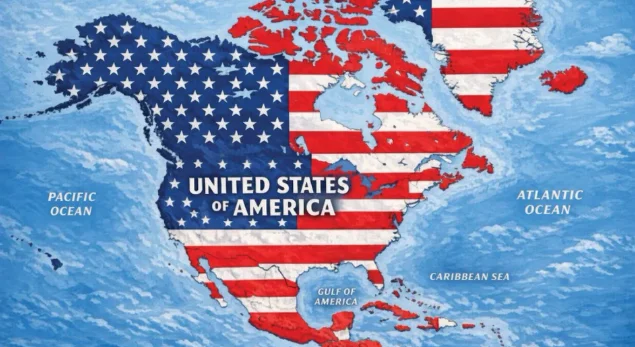
Iceland has summoned the US ambassador after President Donald Trump shared a social media image that appeared to show Iceland and several other countries and territories as part of the United States.
Trump posted the map on his Truth Social account without any accompanying explanation. The image showed the United States, Canada, Greenland, Iceland, Mexico, Central America and the Caribbean covered by the American flag, with the entire area labelled “United States of America.”
Iceland’s Foreign Minister Thorgerdur Katrin Gunnarsdottir called US Ambassador Billy Long to the foreign ministry. According to Iceland’s Foreign Ministry, the ambassador was clearly told that the social media post was “completely inappropriate.”
The incident has created a diplomatic controversy at a time when Trump’s repeated statements about US control or acquisition of Greenland have already caused tensions with Denmark and other European countries.
Greenland is an autonomous territory within the Kingdom of Denmark. Trump has repeatedly argued that Greenland is strategically important to the United States, prompting strong opposition from Denmark and Greenlandic authorities.
The latest map also comes against the backdrop of increased international attention on Greenland. The European Commission recently announced a €200 million ($232.5 million) investment package for Greenland during a visit by Commission President Ursula von der Leyen. Trump’s post appeared just hours after that announcement.
Danish Prime Minister Mette Frederiksen, speaking from Nuuk, reiterated that Greenland’s government and people have consistently opposed becoming part of the United States. She said she hoped there was no doubt about that in either the US or the wider international community.
The US State Department and American diplomatic missions in Copenhagen, Reykjavík and Nuuk had not immediately responded to requests for comment, according to Reuters.
For Iceland, the episode is particularly sensitive because the country is a sovereign NATO member and has its own long-standing diplomatic relationship with Washington. The latest development adds another layer to concerns in Europe over US policy toward the Arctic and North Atlantic.