


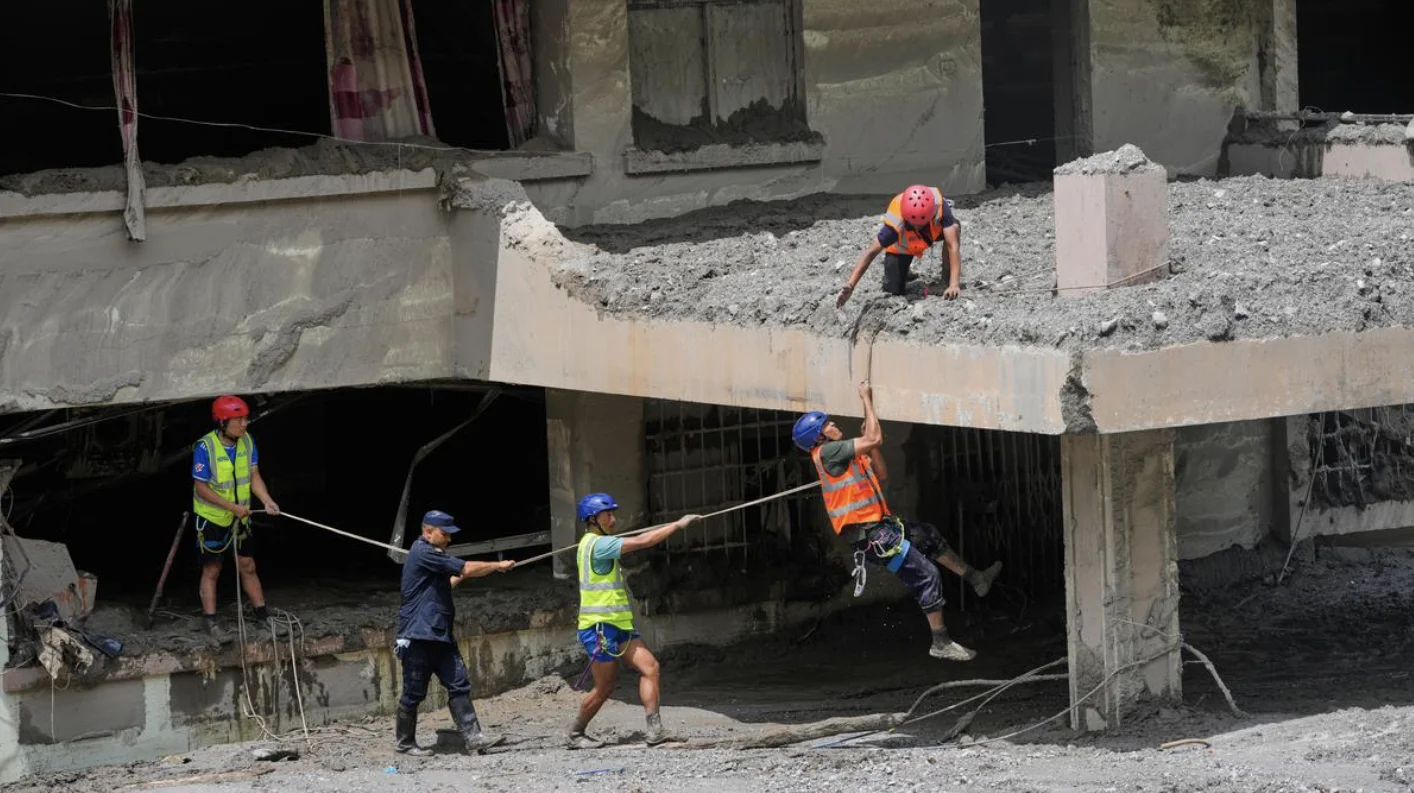
Nepal has stepped up its massive relief and rescue operation following the devastating flash floods that struck the Bhotekoshi-Trishuli corridor and surrounding areas.
Prime Minister Balendra Shah has said the government is using all available resources to rescue stranded people, locate those still missing and provide emergency assistance to affected communities.
According to the latest update from the Prime Minister, 4,451 people have been rescued so far, including 191 workers who were trapped inside hydropower project tunnels.
Helicopters Deployed for Rescue
With roads and bridges damaged across several flood-hit areas, air operations have become an important part of the rescue effort.
A total of 16 helicopters operated by the Nepal Army and private operators have been deployed for shuttle flights to areas including Dhunche, Trishuli, Timure and Syabrubesi.
Authorities have conducted 99 helicopter flights so far to evacuate people and transport essential relief supplies.
However, worsening weather has periodically disrupted the operations. Heavy rainfall and rising water levels in the Trishuli River forced authorities to temporarily suspend some rescue flights, while people living in vulnerable areas were moved to safer locations as a precaution.
Foreign Nationals Given Special Attention
The disaster has also affected foreign tourists and citizens, prompting the government to establish special coordination arrangements for their rescue and identification.
Prime Minister Shah said 129 foreign tourists and citizens have so far been rescued and identified.
Nepal's Ministry of Foreign Affairs is operating an Emergency Control Room to coordinate with foreign embassies and the families of those affected.
More Than 15,000 Security Personnel Mobilised
Nepal has deployed a large security force to support the emergency response.
A total of 15,431 security personnel are involved in search and rescue operations, including 6,755 from the Nepal Army, 4,473 from the Nepal Police and 4,203 from the Armed Police Force.
The teams are working to locate missing people, rescue those trapped in isolated areas and support the distribution of emergency supplies.
Relief Fund Receives Major Support
Financial support for the flood response has grown rapidly.
More than NPR 1.9 billion was collected in the Prime Minister's Disaster Relief Fund within 36 hours, according to the Prime Minister's latest update.
The government has also released NPR 67.5 million to 15 affected local governments for immediate relief, rescue and essential works.
Businesses, banks, insurance companies and individual donors have also contributed significant amounts to the relief fund as the scale of the disaster becomes clearer.
PM and Cabinet to Donate One Month's Salary
Prime Minister Balendra Shah and members of his Cabinet have decided to contribute one month's salary and remuneration to the Prime Minister's Disaster Relief Fund.
The Cabinet has also instructed the Ministry of Finance to prepare a relief and rehabilitation package for individuals and businesses affected by the floods in the Nepal-China border areas and downstream districts.
The move comes as the government prepares to address both immediate humanitarian needs and the longer-term cost of rebuilding damaged communities.
Communications and Power Being Restored
Flooding caused significant damage to Nepal's communications and electricity infrastructure.
The government said 82 of 120 NTC sites and 63 of 78 Ncell sites have resumed operations.
Of the 198 affected telecommunications towers and sites, 145 have been restored so far.
Electricity has also been restored to around 90% of Nuwakot, while authorities are working to restore power in Dhunche and other affected areas.
Damaged Roads Remain a Major Challenge
Restoring road connectivity is crucial for the next stage of the relief operation.
Around 500 metres of a damaged road section near the Trishuli River remains to be repaired, creating a major bottleneck for the movement of rescue teams and vehicles carrying food, medicines and other supplies.
Heavy rain and the possibility of further flooding have also slowed repair work.
Nepal Rejects Reports It Refused Foreign Aid
Prime Minister Shah has rejected reports suggesting that Nepal had refused international assistance.
He said the government remains in continuous coordination with India, China and other international partners for rescue and relief materials.
At the same time, Nepal is assessing the safety and practical requirements of deploying helicopters and other resources in difficult mountainous terrain.
Relief Efforts Enter a Critical Phase
Although thousands of people have already been rescued, the emergency is far from over.
Search teams continue to look for missing people, while authorities are working to provide safe shelter for survivors.
The government is also identifying suitable locations for relocation and attempting to reconnect settlements that have been cut off by damaged roads.
The continuing threat of heavy rain and rising river levels means rescue teams must balance the urgency of their operations with safety concerns.
Focus Shifts Towards Rehabilitation
As immediate rescue operations continue, Nepal is also beginning to prepare for the much larger rehabilitation effort.
The floods have damaged roads, bridges, telecommunications networks, power infrastructure and homes.
Restoring these systems will be essential not only for affected communities but also for the movement of relief supplies and the reopening of economic activity.
The government has therefore begun working on both emergency assistance and longer-term recovery measures.
Public and Private Support Grows
The disaster has triggered a strong response from Nepal's private sector and civil society.
Companies, financial institutions and individuals have contributed to the Prime Minister's Disaster Relief Fund, while organisations have begun distributing food, drinking water, medical supplies, clothing and temporary shelter materials.
The growing contributions are expected to support both immediate relief and the rehabilitation of communities that suffered major losses.
The Road Ahead
Nepal's response is now moving into a critical phase.
The immediate priorities remain finding missing people, treating the injured, evacuating vulnerable communities and ensuring access to food, water and medical care.
At the same time, authorities must restore roads, communications and electricity while preparing for the possibility of additional flooding.
With 4,451 people already rescued, more than 15,000 security personnel deployed and over NPR 1.9 billion raised for the relief fund, Nepal is mounting a large-scale response to one of its most serious recent flood disasters.
The coming days will determine how quickly the country can complete the search operation and move from emergency rescue towards recovery and reconstruction.