A discarded upper stage from a SpaceX Falcon 9 mission eventually ended up on a collision course with the Moon.
The rocket was launched in January 2025 to support Firefly Aerospace's Blue Ghost lunar mission. After completing its primary role, the upper stage remained in space rather than returning to Earth's atmosphere.
Solar activity and gravitational forces gradually altered its trajectory. NASA tracked the object before it impacted the Moon on August 5, 2026, near the Einstein and Bell craters. (nasa.gov)
How Much Space Junk Is Out There?
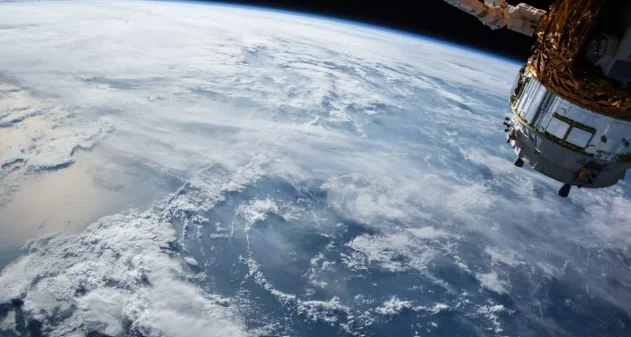
Earth's orbital environment contains a growing mixture of inactive satellites, discarded rocket bodies and fragments produced by launches, explosions and collisions.
Large objects can often be tracked using radar and optical telescopes. The much bigger challenge is the population of smaller fragments.
Many pieces are too small to be routinely tracked but can still pose a serious threat because orbital debris travels at extremely high speeds.
That means the number of objects currently catalogued or tracked does not represent the full amount of material humans have left in space.
Why Tiny Debris Can Cause Major Damage
Spacecraft move at enormous speeds relative to one another. A small fragment hitting a satellite can therefore release enough energy to cause severe damage.
Modern society depends heavily on satellites for communications, navigation, weather forecasting, Earth observation and national security.
A collision involving a critical satellite could disrupt services far beyond the space industry itself.
The Kessler Syndrome Threat
One of the biggest long-term concerns is known as Kessler Syndrome.
The concept describes a possible chain reaction in which one collision creates fragments that cause additional collisions, producing even more debris.
If such a cascade becomes severe in a particular orbital region, it could make some orbits increasingly difficult and dangerous to use.
That is why space agencies and private operators are focusing not only on launching satellites but also on safely disposing of them at the end of their missions.
The Moon Is Becoming Part of the Problem
The Falcon 9 impact also highlights an emerging issue beyond Earth's orbit.
Human-made objects have already accumulated on and around the Moon through decades of exploration. As lunar missions accelerate, more spacecraft, landers and rocket stages could reach the lunar environment.
The prospect of permanent lunar bases and commercial operations raises questions about how abandoned hardware and accidental impacts should be managed. (space.com)
A New Space Race Needs New Rules
The United States, China, India, Japan, Europe and private companies are all expanding their ambitions in lunar and deep-space exploration.
More missions will inevitably mean more hardware in space.
That makes international standards for spacecraft disposal, rocket-stage management, collision avoidance and lunar environmental protection increasingly important.
The Falcon 9 impact was not a threat to Earth, but it serves as a reminder that objects humans leave behind can continue travelling long after their missions have ended.