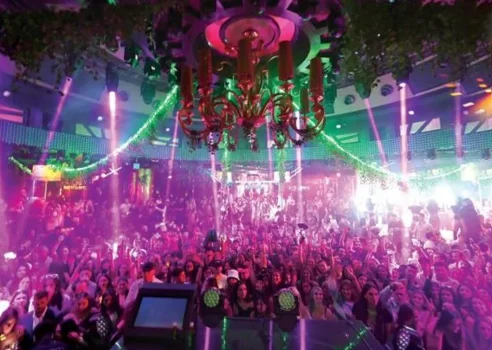
Today, the expression usually suggests a night of celebration — going out with friends, eating, drinking, dancing and staying out late.
But the human desire to gather after dark is much older than the phrase itself.
Across centuries and cultures, cities have created their own versions of nightlife. Some centred on food and drink, others on theatre, music, gambling, festivals or social encounters. What has changed is not the desire to go out at night, but the places and cultures built around it.
Before the modern nightclub
Nightlife did not begin with bars and nightclubs.
For much of history, evening entertainment was connected to community celebrations, religious ceremonies, markets, festivals, theatres and social gatherings. As cities grew, specialised districts developed where people could eat, drink, watch performances and meet others after sunset.
In Japan, traditions surrounding colour, ceremony and public life developed over centuries. Red itself acquired powerful cultural associations across East Asia, including links with celebration, status and auspicious occasions. By around the eighth century, red-painted temples and palaces had become part of Japanese visual culture.
Japan's later urban nightlife developed in more commercial forms, with entertainment districts, restaurants, theatres and establishments that stayed open late. By the modern era, Japanese cities had developed complex night-time economies serving workers, students, tourists and people looking for entertainment after dark.
The phrase “paint the town red”
The expression itself has a colourful but uncertain history.
One of the most popular stories connects it to 1837, when the Marquess of Waterford and his companions allegedly went on a drunken spree in Melton Mowbray, England, and literally painted buildings and other objects red.
It is an entertaining explanation, but historians of language caution against treating it as established fact. The phrase was not recorded in print until decades later, with examples appearing in the United States in the 1880s.
The expression eventually came to mean having an unusually lively or extravagant night out.
The “red” in the phrase has therefore become less about actual paint and more about the imagery of excitement, excess, celebration and sometimes disorder.
Cities that never really sleep
As urban populations expanded, nightlife became increasingly important to city life.
Restaurants, theatres, dance halls, cafés, music venues and later cinemas and nightclubs transformed the evening into an economic and cultural space.
Nightlife also became a way for cities to create identities. Paris became associated with cabarets, New York with its clubs and theatres, Tokyo with its dense entertainment districts, and other cities developed their own distinctive after-dark cultures.
The modern nightlife economy is therefore about much more than alcohol. It encompasses food, music, fashion, performance, tourism, transport and hospitality.
Macau and the evolution of nightlife
Few places demonstrate the connection between entertainment, tourism and nightlife as clearly as Macau.
Located at the intersection of Chinese and Portuguese cultural influences, Macau developed a distinctive urban culture over centuries. Portugal established a permanent trading settlement there in the 16th century, and the city became an important intermediary point in regional trade. Macau eventually became a Special Administrative Region of China in 1999.
Its nightlife later became closely associated with casinos, hotels, restaurants, performances and entertainment.
Historic establishments such as the Central Hotel brought together accommodation, restaurants, bars, music, nightlife and gambling under one roof, illustrating how entertainment districts could become miniature economies of their own.
Modern Macau expanded that model dramatically, developing into one of the world's best-known gaming and tourism destinations.
From physical streets to digital nightlife
The biggest transformation may be happening now.
Nightlife is no longer confined to a particular street or neighbourhood. Social media can turn a restaurant, club or festival into a destination almost overnight.
People increasingly discover nightlife through Instagram, TikTok, online reviews and travel platforms. A city's after-dark reputation can now spread globally before a visitor has even arrived.
At the same time, younger generations are experimenting with different forms of socialising. The current nightlife landscape includes sober parties, coffee raves, live experiences and events that do not revolve around alcohol. Author Imogen Willetts, whose 2026 book Up All Night: A History of Going Out examines the history of nightlife, has even suggested that younger generations could eventually help create another nightlife revival.
What does “going out” mean now?
The history of nightlife suggests that the night-time city is constantly reinventing itself.
What once meant visiting a tavern or festival may later have meant dancing in a ballroom, watching a cabaret, gambling in a casino or spending hours inside a nightclub.
Today it could mean anything from a late-night street-food crawl to a concert, a café gathering, a sober dance event or a luxury hotel experience.
So perhaps “painting the town red” has survived because the phrase is flexible enough to accommodate all of these changes.
The colour may be metaphorical, but the instinct behind it remains familiar: when the day ends, people still want to gather, celebrate, explore and experience their cities in a different way.