



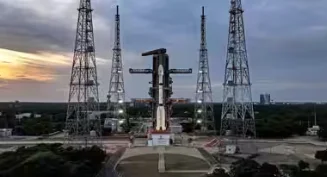
The Indian Space Research Organisation (ISRO) is set for another significant space mission with the planned launch of EOS-05, also known as GISAT-1A. The satellite will be carried into space by GSLV-F17, the 19th flight of India’s Geosynchronous Satellite Launch Vehicle.
The launch is scheduled for 2:55 AM IST on September 4, 2026, from the Second Launch Pad at the Satish Dhawan Space Centre in Sriharikota, Andhra Pradesh. ISRO has already begun preparations and the countdown is underway.
Why EOS-05 is important
The biggest feature of EOS-05 is its intended geosynchronous orbit, at an altitude of roughly 36,000 kilometres above Earth. Unlike many Earth-observation satellites in low Earth orbit that pass over a particular location periodically, a geosynchronous satellite can repeatedly observe the same broad region.
This gives EOS-05 the potential to provide more persistent observation of the Indian subcontinent and surrounding areas. Such capability can be valuable for border monitoring, weather observation, disaster management, agriculture, environmental monitoring and other strategic applications.
For national security, the ability to frequently observe strategically important areas could provide authorities with additional space-based information for monitoring developments along India’s borders with China and Pakistan. However, the satellite is designed for both civilian and strategic applications rather than being exclusively a military surveillance platform.
A different kind of space-based observation
Most of India’s existing imaging satellites operate in lower orbits and move around Earth, meaning a particular location can only be revisited after a certain interval. EOS-05 is designed to offer a different capability by maintaining a persistent view of a large geographical region.
ISRO describes EOS-05 as India’s first-ever imaging satellite from geosynchronous orbit. The spacecraft will initially be placed into a Sub-Geosynchronous Transfer Orbit by GSLV-F17 and will subsequently use its own propulsion system to reach its operational orbit.
Why the GSLV launch matters
The mission also carries significance for the GSLV programme. The GSLV has previously faced technical setbacks, including the unsuccessful GSLV-F10 mission in August 2021. The upcoming flight will therefore be closely watched as ISRO seeks to demonstrate the reliability of the launch vehicle while placing an important Earth-observation spacecraft into orbit.
The GSLV-F17 stands approximately 51.7 metres tall and uses a three-stage configuration that includes India’s indigenous cryogenic upper stage.
If successful, EOS-05 will give India a new capability for persistent Earth observation from geosynchronous orbit, strengthening both civilian monitoring and the country’s ability to keep a closer watch on strategically important regions.