


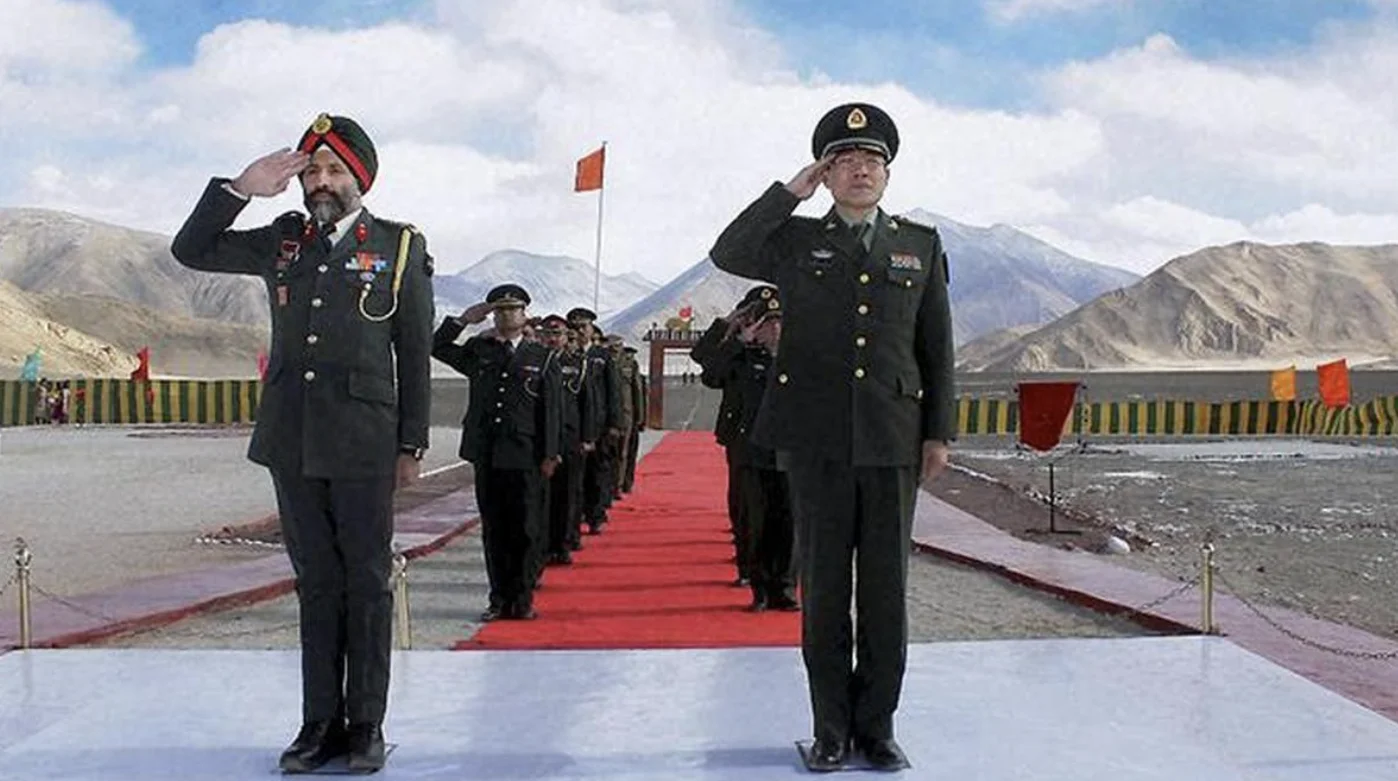
India and China have agreed to establish two additional border meeting points for senior military commanders as part of efforts to improve communication and border management along the Line of Actual Control (LAC).
However, the exact locations of the two new meeting points have not yet been announced. The sites are expected to be finalised through consultations between the two sides.
The decision was among the key outcomes of the latest round of high-level boundary talks between India and China.
Decision Taken During Beijing Talks
The agreement was reached during the 25th round of Special Representatives’ talks on the India-China boundary question held in Beijing on August 25.
India’s National Security Adviser Ajit Doval and Chinese Foreign Minister Wang Yi led the discussions.
The talks covered the boundary question as well as measures to maintain peace and stability along the border, improve military communication and strengthen broader bilateral engagement.
The two sides subsequently released an eight-point consensus that included the decision to establish two additional border meeting points.
Locations Yet to Be Decided
While the decision to create the new meeting points has been reached, their exact locations remain undecided.
The two sides will need to consider geographical conditions, military deployment patterns, communication facilities and security requirements before finalising the sites.
The locations are expected to be determined through consultations between Indian and Chinese authorities.
Strengthening Military Communication
The main purpose of the new meeting points is to provide additional channels of direct communication between senior military commanders.
The LAC has several areas where India and China have differing perceptions of the boundary. Any face-to-face situation between troops in such areas can potentially create tensions.
Direct meetings between commanders can help address misunderstandings quickly and prevent local incidents from developing into wider confrontations.
Existing Border Meeting Points
India and China already have several Border Personnel Meeting points.
Important existing locations include Spanggur Gap, Nathu La and Bum La, where military personnel from the two sides can meet to discuss local issues and prevent misunderstandings.
The creation of two additional centres would expand this existing communication mechanism.
Earlier Agreements Also Envisaged More Points
The expansion of border meeting points is not a completely new concept.
The 2005 India-China protocol had already provided for expanding the mechanism to include areas such as Kibithu-Damai in the Eastern Sector and Lipulekh Pass/Qiang La in the Middle Sector.
The protocol said that the precise locations would be decided through mutual consultations.
The latest announcement has therefore renewed interest in where the two new meeting points will eventually be established.
Importance After the 2020 Border Crisis
Military communication has assumed greater importance in India-China relations since the 2020 Galwan clash.
The experience of the past several years has highlighted the need for reliable communication channels that allow local and senior commanders to address emerging situations before they escalate.
Alongside the two new meeting points, India and China have also agreed to establish two additional military hotline channels in the Eastern and Middle sectors.
A Confidence-Building Measure
The new meeting points do not represent a settlement of the India-China boundary dispute.
The two countries continue to have differences over the alignment of the LAC and the larger boundary question.
However, mechanisms that improve communication can serve as confidence-building measures while negotiations over the boundary continue.
Broader Boundary Negotiations
During the latest Special Representatives’ talks, India and China reaffirmed their commitment to negotiations aimed at achieving a fair, reasonable and mutually acceptable settlement of the boundary question.
The two sides also discussed mechanisms to improve border management and advance discussions on boundary delimitation.
The new meeting points are therefore part of a broader effort to manage the disputed frontier while diplomatic negotiations continue.
How the New Points Could Help
Additional meeting centres could make it easier for commanders to communicate when patrols encounter one another or when disagreements arise over local activities.
Instead of allowing a local incident to remain unresolved, commanders could use the meeting mechanism to clarify positions and seek a quick solution.
This could reduce the possibility of accidental escalation along the LAC.
What Happens Next?
The immediate task for India and China will be to determine the exact locations of the two new meeting points.
The countries will also need to work out operational details, including which commanders will use the facilities, how meetings will be requested and how frequently they will be held.
These arrangements are expected to be worked out through military and diplomatic consultations.
Wider Significance
The decision comes at a time when India and China are attempting to stabilise bilateral relations after years of tensions along the border.
Improved military communication could help create greater predictability along the LAC, even while the larger boundary dispute remains unresolved.
The new mechanism will be particularly important in areas where the two sides have different perceptions of the LAC.
Conclusion
India and China have agreed to establish two additional border meeting points for senior military commanders, but the exact locations have yet to be finalised. The initiative is intended to strengthen direct military communication and reduce the risk of local incidents along the LAC escalating into larger confrontations.
The agreement was reached during the 25th round of Special Representatives’ talks in Beijing and forms part of a broader eight-point understanding between the two countries.
Along with the new meeting points, the two sides have also agreed to establish additional military hotline channels. The measures do not resolve the underlying boundary dispute, but they could provide important communication and confidence-building mechanisms while negotiations continue.