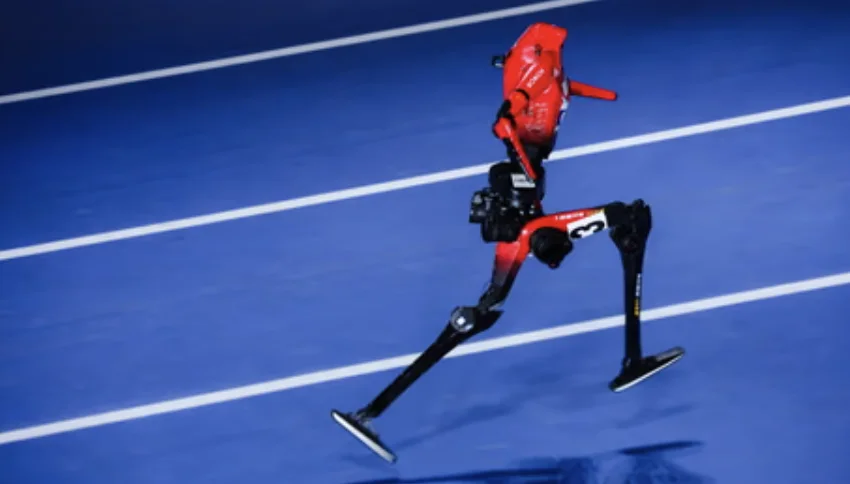
China is putting its growing humanoid robotics capabilities on display through a sporting event designed specifically for machines that can move and compete in ways similar to humans.
At the World Humanoid Robot Games, Chinese-built humanoid robots took part in running, football and other physical competitions, with some reportedly surpassing human records in selected events.
The competition offers a different way of testing robots. Instead of operating in carefully controlled laboratory conditions, the machines have to deal with movement, balance and unexpected situations on a sports field.
Running is particularly demanding for a humanoid robot. Maintaining balance while moving quickly requires several systems to work together, including sensors, motors, motion-control software and artificial intelligence.
A robot has to constantly adjust its posture and foot placement as it accelerates, turns or encounters changes on the track. Even a small error in timing or balance can cause the machine to fall.
The event also featured robot football, another challenging test of machine coordination. Robots were required to identify the ball, estimate its position, move towards it and attempt to control or kick it.
Although robot football remains far from matching the speed and decision-making abilities of human players, competitions such as this provide researchers with a useful environment for testing machine vision, movement planning and real-time decision-making.
The ability to recover from a fall is another important aspect of humanoid robot development. A machine designed for real-world environments cannot simply stop functioning after losing its balance.
Researchers therefore pay close attention to how quickly a robot can detect that it is falling, protect its hardware and regain an upright position.
The sporting events also highlight the growing role of artificial intelligence and computer vision in robotics. A modern humanoid robot needs to interpret its surroundings, identify objects and make decisions while simultaneously controlling its physical movements.
China has invested heavily in humanoid robotics in recent years. Companies and research institutions are developing machines for potential applications ranging from manufacturing and logistics to healthcare and domestic services.
Sport provides an accessible way to demonstrate these developments to the public. Watching a robot run, compete for a ball or recover after falling makes technological progress easier to understand than demonstrations conducted entirely inside a laboratory.
However, breaking a human record is only one measure of a robot's capabilities. For commercial applications, other factors are likely to matter just as much.
Robots will need to operate safely around people, consume energy efficiently, remain reliable for long periods and perform useful tasks in unpredictable environments.
The World Humanoid Robot Games therefore serve both as a competition and as a testing ground. Engineers can identify weaknesses in robotic movement, improve control systems and compare different approaches to humanoid design.
The event also reflects China's broader ambition to become a major force in advanced robotics. As the technology develops, humanoid machines could eventually take on tasks that currently require people to perform repetitive or physically demanding work.
For now, the competition provides a glimpse of what these machines can already do. Their ability to run, maintain balance and participate in sporting events shows how quickly humanoid robotics is moving from laboratory experiments towards more sophisticated real-world applications.