



Poseidon Raises $60 Million
Poseidon Aerospace has closed a $60 million Series A round after raising $11 million in seed funding last year.
TQ Ventures led the latest round, with new investment from Hanwha Asset Management, G Squared and JAWS. Existing investors including Starship Ventures, Draper Associates and Drover Ventures also participated.
Egret Set for First Pilotless Test
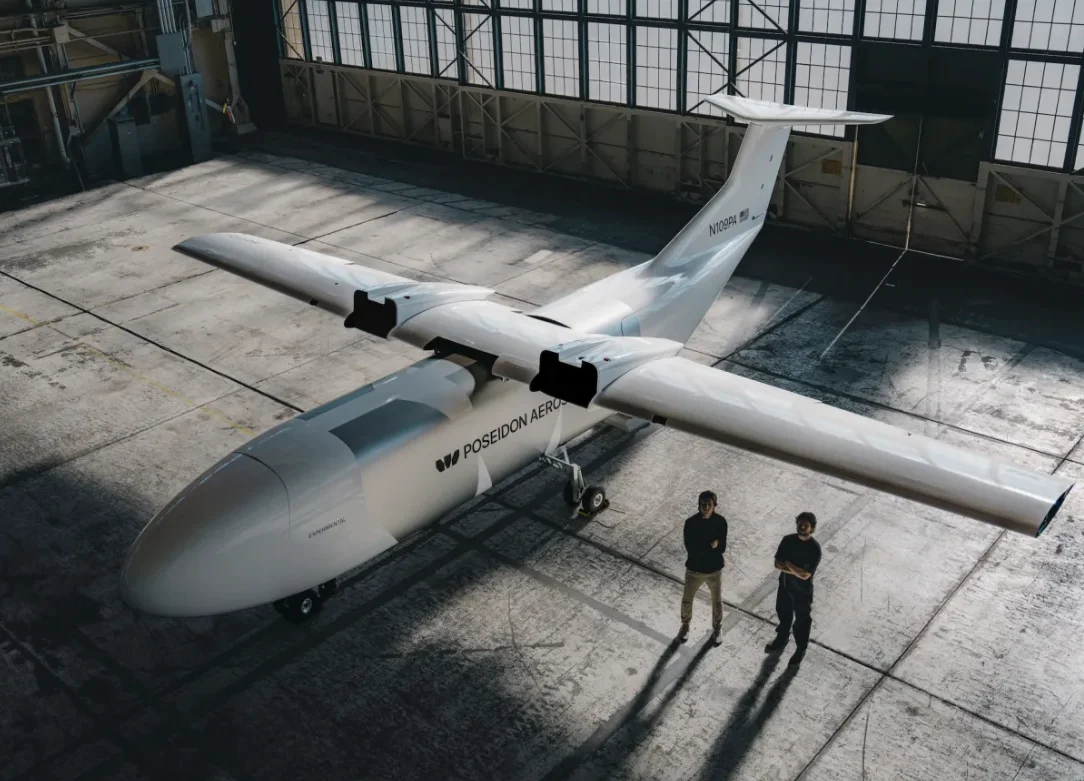
The funding comes as Poseidon prepares for the first test flight of its Egret uncrewed cargo aircraft.
The company expects the aircraft to conduct its first test flight by the end of this year. Poseidon previously developed and flew a quarter-scale prototype called Seagull.
The company has now expanded into an old Navy hangar in Alameda, California, where it is preparing to build and test the full-size aircraft. Egret has a wingspan of about 50 feet.
A Different Approach to Advanced Aviation
Poseidon is deliberately avoiding some of the expensive technologies pursued by other advanced-air-mobility startups.
Instead of vertical takeoff and landing systems, Egret is a conventional fixed-wing aircraft. Both Egret and its seaplane variant, Heron, use traditional combustion engines.
The company argues that conventional fuel still offers strong energy density and that the simplest way to transform air cargo is to build an aircraft capable of moving goods at much lower cost.
Why Remove the Pilot?
Poseidon believes eliminating the cockpit and pilot-related systems can significantly reduce aircraft weight and operating costs.
Removing life-support equipment and other cockpit-related structures also allows the company to improve the aircraft’s payload-to-empty-weight ratio.
The startup expects autonomous aircraft to operate with higher utilisation because they will not face the same pilot-hour, scheduling and overnight accommodation constraints as conventional cargo aircraft.
Defense and Regional Cargo Are Initial Targets
Poseidon is initially targeting defense and regional commercial cargo markets.
On the defense side, the company sees potential in serving remote communities and routes where conventional air cargo infrastructure is limited or nonexistent.
Aircraft capable of operating in areas with degraded infrastructure could also provide greater resilience for military and national logistics networks.
Poseidon Plans to Operate the Aircraft Itself
Unlike many aerospace startups that plan to sell aircraft to customers, Poseidon intends to operate its own regional air cargo business.
The company wants to compete with established carriers for cargo business from companies such as UPS and FedEx.
Operating its own fleet could also allow Poseidon to adjust routes more quickly when demand changes across different regions.
A Point-to-Point Cargo Network
Poseidon also sees autonomous aircraft as a way to move beyond the traditional hub-and-spoke model.
Instead, the company envisions more direct point-to-point regional cargo flights. Without pilots who need to return to a particular base or observe flight-hour limitations, aircraft could potentially be used more flexibly.
Regulatory Environment Improving
Poseidon is also benefiting from an aviation regulatory environment that the company believes is becoming more receptive to new aircraft technologies.
The Federal Aviation Administration has recently introduced a pilot programme aimed at making testing easier for certain advanced aircraft startups. Although Poseidon is not developing an electric VTOL aircraft, CEO David Zagaynov said the broader regulatory changes could still benefit the company.
Conclusion
Poseidon Aerospace’s $60 million Series A gives the startup additional capital to pursue its ambitious vision of lower-cost, pilotless air cargo.
Its Egret aircraft combines autonomous operation with a conventional fixed-wing design and combustion propulsion, deliberately avoiding some of the more complex technologies being pursued elsewhere in advanced aviation.
If the planned test flight later this year succeeds, Poseidon could take an important step toward proving that autonomous aircraft can become a practical and economically viable option for regional cargo transportation.