


Thunder Can Shake the Ground
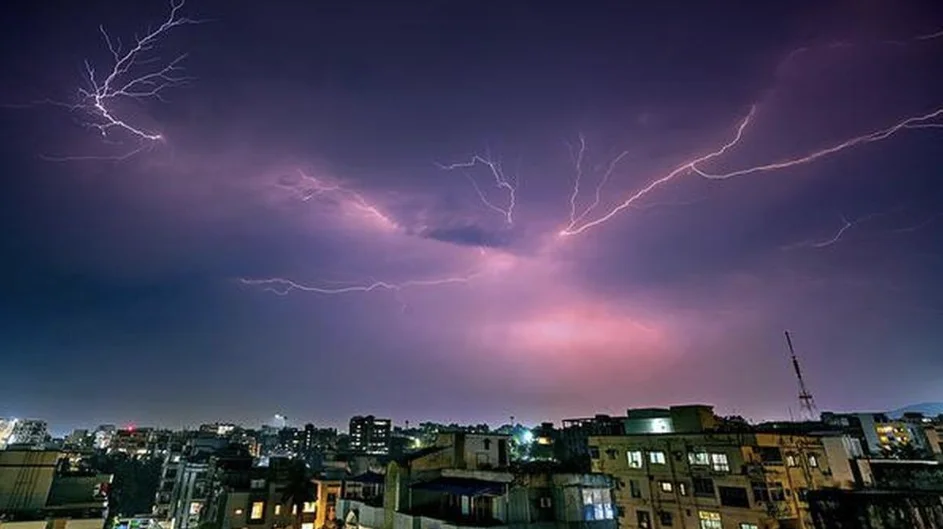
Lightning superheats the surrounding air and creates a powerful shock wave that we hear as thunder.
But some of that energy also reaches the ground and is converted into seismic waves that travel through soil and rock. Scientists refer to these ground-coupled vibrations as thunderquakes.
Fibre-Optic Cable Becomes a Seismic Sensor
Researchers working as part of Penn State's FORESEE project used an old telecommunications fibre-optic cable as a large-scale vibration sensor.
Using Distributed Acoustic Sensing (DAS), they turned a cable more than 4 kilometres long into more than 2,100 closely spaced sensors capable of listening to ground vibrations simultaneously.
458 Thunderquakes Recorded
Over a two-year period, the researchers identified 458 clear, high-quality thunderquake signals.
The large volume of data allowed them to examine specific seismic waves generated when atmospheric sound interacts with the ground.
How the Technique ‘X-Rays’ the Ground
The method relies on seismic dispersion.
Seismic waves at different frequencies travel to different depths. By measuring how the speed of thunderquake waves changes with frequency, researchers can reconstruct seismic-wave speeds at different depths and infer the properties of underground material.
The result is effectively an X-ray-like image of the subsurface extending roughly 100 metres underground, without drilling a borehole.
Why It Could Matter for Cities
Traditional subsurface surveys can require expensive vibration sources and specialised arrays of sensors.
Thunderstorms provide a naturally occurring seismic source, while fibre-optic cables are already buried beneath many cities and towns.
Using the two together could eventually allow scientists to monitor shallow underground structures more continuously and at lower cost.
Detecting Weak Zones and Sinkhole Risks
The researchers tested the technique in State College, Pennsylvania, an area dominated by limestone and dolomite.
Groundwater can gradually dissolve these rocks, creating fractures, caves and sinkholes.
The thunderquake measurements revealed four distinct underground weak zones. Two of them corresponded with areas where satellite radar indicated active ground subsidence.
Potential Applications
The technique could eventually help with:
Monitoring groundwater movement
Detecting environmental contamination
Identifying sinkhole-prone areas
Assessing building sites and foundations
Monitoring buried infrastructure
Mapping shallow underground geological structures
Such applications could be particularly valuable in rapidly growing urban areas.
Thunder Is Only One Natural Source
The principle may extend beyond thunderstorms.
Sonic booms, volcanic eruptions and meteor airbursts can also generate atmospheric shock waves that may be converted into seismic energy at the ground.
Could It Work Beyond Earth?
Researchers also see a possible future application beyond Earth.
Titan, Saturn's largest moon and the target of NASA's upcoming Dragonfly mission, could be an intriguing candidate. If lightning and thunder occur there as models predict, atmospheric energy might provide another way to investigate its subsurface.
Conclusion
Thunderstorms could become a natural tool for imaging what lies beneath our cities.
By combining naturally generated thunderquake vibrations with existing fibre-optic infrastructure, researchers have demonstrated a potentially inexpensive, non-invasive way to map the shallow subsurface. The technique could eventually support urban planning, infrastructure monitoring, groundwater studies and sinkhole-risk assessment.