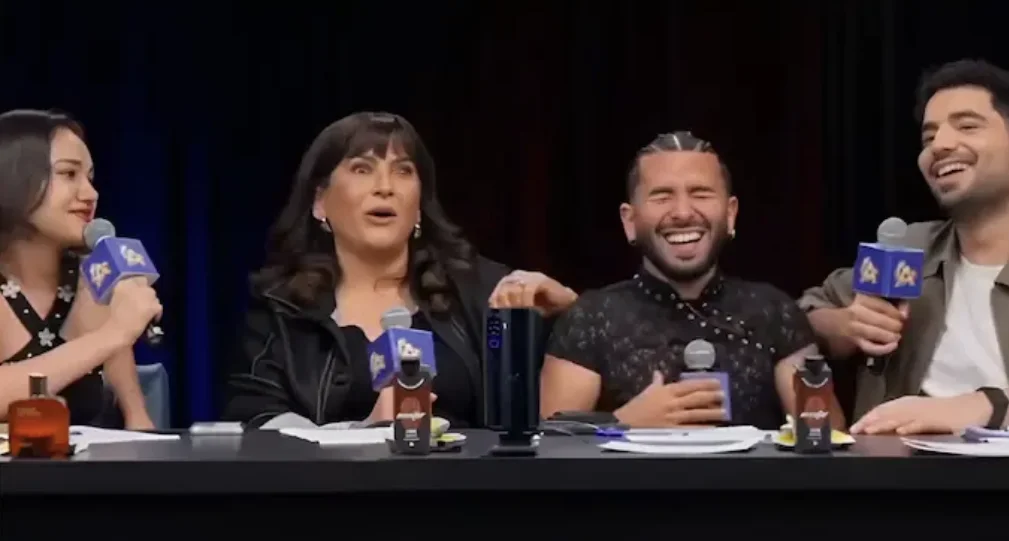
A roast exchange between Samay Raina and Sharon Verma on Season 2 of India’s Got Latent has sparked a fresh controversy online, with viewers divided over whether their jokes crossed the line from comedy into insensitive commentary.
What began as playful banter about their respective backgrounds quickly turned into a Bihar-Kashmir exchange, with references to regional stereotypes, migration and the displacement of Kashmiri Pandits.
How the Controversy Started
During the latest episode, Samay Raina began teasing Sharon Verma over her Bihari background.
His joke played on stereotypes surrounding Bihari pronunciation and language. Sharon then responded with a joke targeting Raina’s Kashmiri identity, referring to stone-pelting associated with periods of unrest in Kashmir.
The exchange continued as both comedians attempted to outdo each other with increasingly pointed jokes.
Sharon Verma’s Kashmir Joke
Sharon’s response became particularly controversial because it referenced stone-pelting in Kashmir.
Raina comes from a Kashmiri Pandit family and has previously spoken publicly about his family’s experience of leaving Kashmir during the displacement of Kashmiri Pandits in the early 1990s.
Because of that personal history, some viewers felt that the reference was more sensitive than a conventional roast joke.
The Bihar-Mumbai Exchange
The exchange then moved back to Bihar.
Raina brought up migration from Bihar to Mumbai for employment and joked about Sharon having moved to Mumbai in search of a job.
Sharon responded with a line that many viewers interpreted as a reference to the displacement of Kashmiri Pandits, saying that she had at least left her state by choice.
The remark quickly became one of the most discussed parts of the exchange after clips from the episode circulated online.
Why the Reference to Kashmiri Pandits Matters
The displacement of Kashmiri Pandits in the early 1990s remains a deeply sensitive issue.
As militancy and violence escalated in the Valley, large numbers of Kashmiri Pandit families left their homes and livelihoods.
Raina has previously spoken about his own family’s experience, saying that they left Kashmir believing they would return within weeks, but ultimately remained away for decades.
That background has added another layer to the reaction surrounding the latest episode.
Social Media Reactions
Clips of the exchange quickly spread across social media, with viewers sharply divided.
Some criticised the comedians for using regional stereotypes and references to historical suffering as material for entertainment.
Others defended the segment, arguing that both Raina and Verma were participating in a roast and that the jokes were directed at each other rather than being one-sided attacks.
Some viewers also praised Verma for her comeback and described the exchange as an example of aggressive roast comedy.
Political Criticism
The controversy also attracted political attention.
BJP leader and Maharashtra MLA Ram Kadam criticised Raina over the remarks and accused him of making controversial statements to gain publicity.
Kadam argued that issues concerning Kashmiri Pandits and religious sentiments should not be treated as subjects for ridicule.
His comments added a political dimension to what had initially been an entertainment-related controversy.
Samay Raina’s History of Controversies
This is not the first time Raina and India’s Got Latent have been caught up in controversy.
The first season became embroiled in a major row in 2025 after an episode featuring Ranveer Allahbadia generated widespread outrage over an inappropriate remark. Multiple complaints and FIRs followed, and Raina was questioned by Maharashtra Cyber.
The controversy eventually led to the removal of the show’s episodes from YouTube.
Season 2 marked the show’s return, making the latest controversy another significant moment for the programme.
Where Does Roast Comedy Draw the Line?
The latest debate has renewed questions about the boundaries of roast comedy.
Regional identity, accents and personal backgrounds are common subjects in roast performances. However, when jokes involve historical displacement, violence or communal and political conflict, audiences may view them differently.
For some, the context makes the jokes uncomfortable even when they are delivered as part of a mutual roast.
Two Different Views
The reaction to the episode largely falls into two camps.
One side argues that the comments should be understood within the format of a roast, where comedians deliberately use provocative material to entertain an audience.
The other side believes that comedy should not rely on real-world tragedies or painful historical experiences, particularly when those experiences continue to affect communities and families.
The disagreement has kept the Bihar-Kashmir exchange at the centre of online discussion.
Broader Debate Around Comedy
The controversy also reflects a wider debate in India over the relationship between comedy and social sensitivity.
Comedians increasingly use political, regional and cultural identities as material, while social media allows short clips to reach audiences far beyond the original show.
A joke that may have been understood as a roast within a live studio setting can therefore acquire a very different meaning when isolated and shared online.
Conclusion
The Samay Raina-Sharon Verma Bihar-Kashmir roast on India’s Got Latent has sparked a debate over the limits of comedy after the exchange touched on regional stereotypes, migration and the displacement of Kashmiri Pandits.
While some viewers have criticised the jokes as insensitive, others have defended them as part of a mutual roast between two comedians. Political criticism has further intensified the controversy.
The episode has ultimately raised a broader question: how far can comedians go when humour draws on real identities, historical trauma and events that remain deeply sensitive to millions of people?