



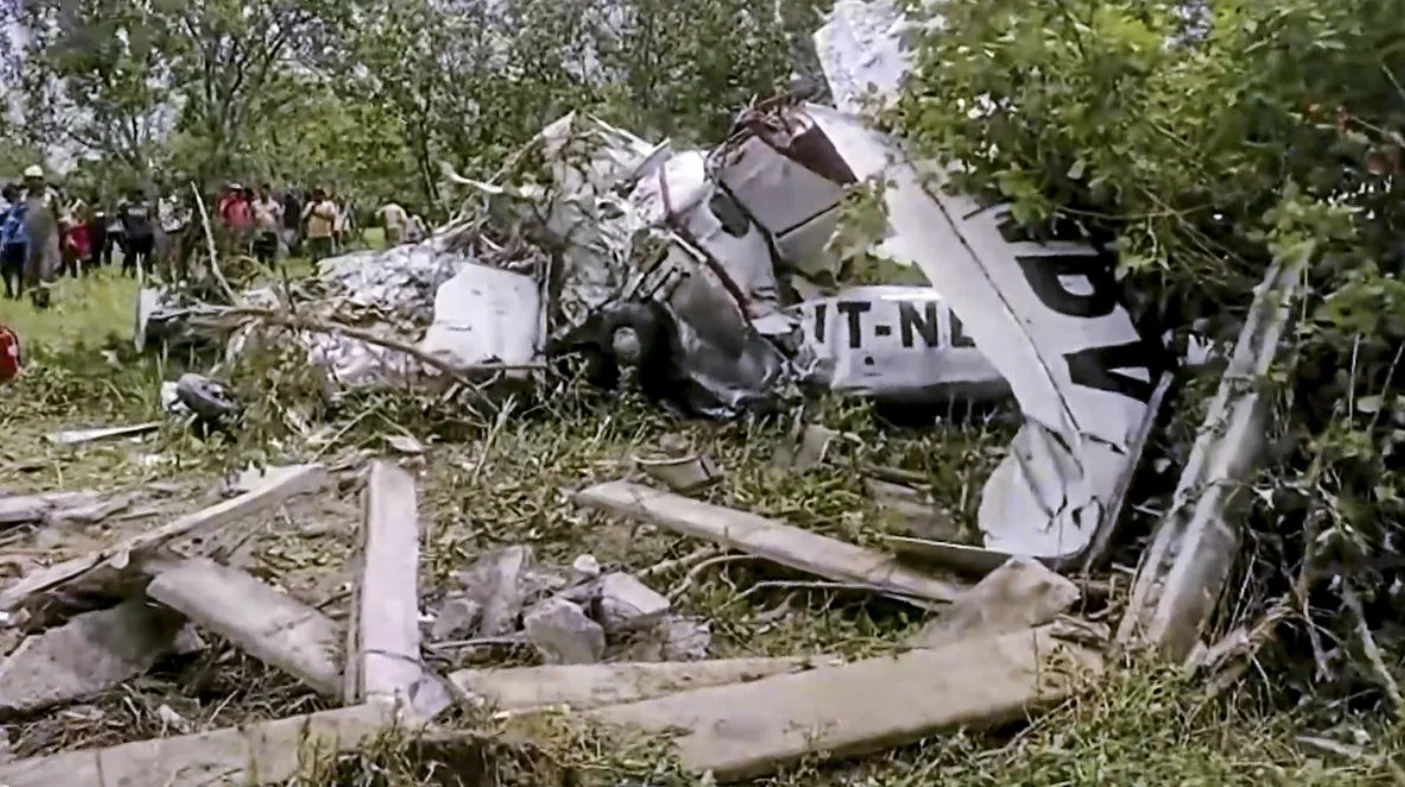
A training flight ended in tragedy in Uttar Pradesh's Kanpur on Thursday after a twin-engine aircraft crashed near the Ganga Barrage, killing both people on board.
The aircraft was operated by Garg Aviation and was being used for pilot training. It came down near Natthupurwa village in the Katri area, close to the Ganga Barrage.
The aircraft was identified as a Tecnam P2006T, a four-seat, twin-engine aircraft used for flight training. Its Indian registration was VT-NBV and it was operated by Garg Aviation Ltd., based in Kanpur.
There were two people on board: flight instructor Sachin Bhatia, from Gujarat, and trainee pilot Abhishek Pujari, from Karnataka.
Both suffered fatal injuries in the crash.
Kanpur Police Commissioner Raghubir Lal said Bhatia had around 3,000 hours of flying experience.
The aircraft took off from the Garg Aviation training centre at around 11:30am.
About 20 minutes later, while returning towards the training centre, it crashed into a field near Natthupurwa village, close to the Ganga Barrage.
Police, emergency personnel and administrative officials rushed to the site after receiving information about the crash.
The aircraft was severely damaged and debris was scattered around the field. Authorities secured the area and began collecting evidence as part of the initial response.
The aircraft was not operating a passenger service.
It was conducting a pilot-training sortie, which explains why an instructor and a trainee were flying together.
Training flights are designed to give student pilots practical experience under the supervision of qualified instructors.
The exact cause of Thursday's accident remains unknown.
Initial reports have suggested that the aircraft may have lost control, but authorities have not established why the aircraft went down.
There is currently no official finding confirming that the crash was caused by mechanical failure, pilot error, weather or any other specific factor.
The Directorate General of Civil Aviation, or DGCA, has been informed of the accident.
A team of DGCA officials is expected to reach the site to provide regulatory oversight and coordinate the initial investigation.
The Aircraft Accident Investigation Bureau (AAIB) has also been informed and will conduct the detailed investigation under the applicable aviation rules.
The investigation will be important in establishing what happened during the final minutes of the flight.
Investigators are expected to examine the wreckage, aircraft records, maintenance history, operational documents and other available evidence.
They may also examine the aircraft's flight path and determine whether anything unusual occurred before the crash.
The accident occurred approximately five nautical miles from Kanpur Civil Airport, according to preliminary information released by aviation authorities.
The aircraft was flying within the local flying area of Kanpur Civil Airport when the accident occurred.
Garg Aviation operates pilot-training activities from the Kanpur civil aerodrome.
The Tecnam aircraft involved in the crash was reportedly brought to the training centre in 2023, although its complete maintenance and airworthiness history will need to be established through the official investigation.
The crash has also drawn attention to safety in flight-training operations.
Training aircraft are used extensively by aspiring pilots to build practical flying experience. Their safety depends on several factors, including aircraft maintenance, instructor supervision, operational procedures and the ability to respond to emergencies.
However, there is currently no official evidence linking the Kanpur crash to any particular maintenance or operational failure.
It would therefore be premature to identify a specific cause before investigators complete their work.
Authorities have so far not reported injuries among people on the ground.
The two people aboard the aircraft were the confirmed fatalities in the accident.
Investigating an aircraft accident can take time.
Investigators typically examine the wreckage for signs of mechanical failure or structural damage, while also reviewing available records and operational information.
The condition of engines and other components can provide important clues about what happened before impact.
Investigators may also examine whether the aircraft experienced an emergency during the return flight and whether any communication was made before the crash.
At this stage, the confirmed sequence is straightforward.
The Garg Aviation aircraft departed from Kanpur for a training flight at about 11:30am.
Roughly 20 minutes later, it crashed near the Ganga Barrage while returning towards the training centre.
The instructor and trainee pilot on board were killed.
The precise reason for the crash remains under investigation.
The accident is likely to prompt renewed attention to safety standards at flight-training organisations.
Questions around aircraft maintenance, operational procedures, instructor oversight and regulatory checks may form part of the broader investigation.
The DGCA and AAIB findings will be important in determining whether there were any technical or operational factors that contributed to the accident.
Until those findings are released, speculation about the cause should be avoided.
Aviation accident investigations are intended not only to establish responsibility or determine what went wrong, but also to identify lessons that can prevent similar incidents in the future.
The final report could therefore contain recommendations for flight-training operators, regulators and other aviation organisations.
For the families of the two pilots, however, the immediate reality is the loss of two lives.
Sachin Bhatia was an experienced instructor, while Abhishek Pujari was undergoing training to build his own aviation career.
Their deaths have deeply affected the flight-training community.
The Kanpur crash also highlights the risks associated with aviation training, where student pilots must gain practical experience while operating aircraft in real flying environments.
The investigation will now focus on understanding what happened during this particular flight.
Officials will need to determine whether the aircraft developed a technical problem, whether there was an operational difficulty or whether another factor contributed to the accident.
Only after the evidence has been examined can a reliable conclusion be reached.
For now, the authorities have confirmed the location, the aircraft type, the training purpose of the flight and the deaths of the two occupants.
The cause remains unconfirmed.
The DGCA and AAIB investigation is therefore expected to provide the next major update on the case.
Its findings could also determine whether any changes are required in aircraft maintenance procedures, flight-training practices or aviation safety oversight.
The tragedy near Kanpur's Ganga Barrage is thus not only a fatal accident involving two pilots but also an important aviation-safety case.
The eventual investigation will establish what happened and, more importantly, what can be done to prevent a similar accident from occurring again.